
 +34 611 898 442


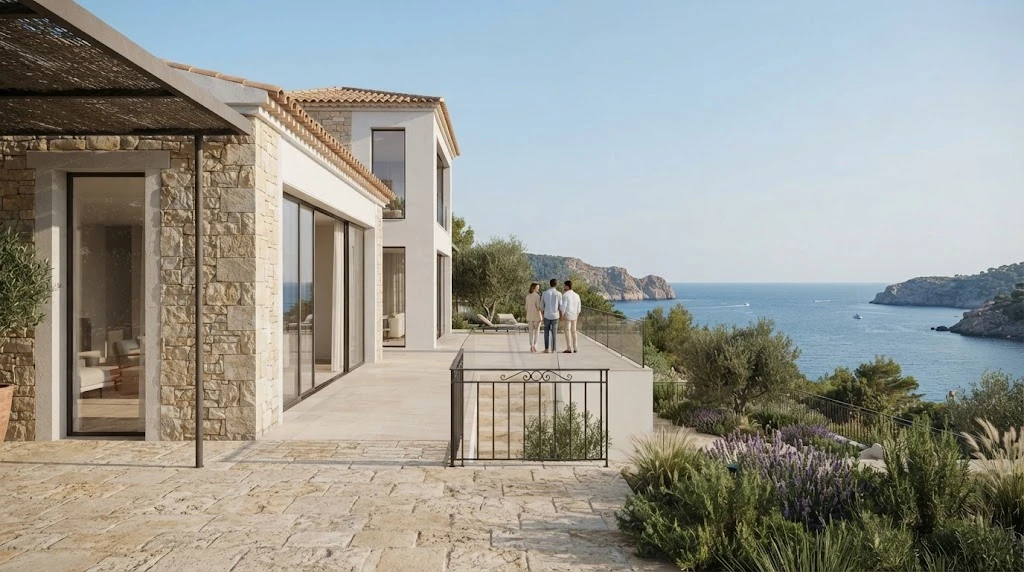
Choosing a luxury sea-view villa in Spain starts with the town, but the decision is really made at the level of the individual plot. Two villas a few hundred metres apart can have very different views, gradients, legal positions and walking distances to the beach. This guide compares seven coastal towns we consider strong candidates, then explains how to judge the view, the price and the legal checks before you commit to viewings.
Marbella, Estepona, Moraira, Jávea, Altea, Begur and Andratx are seven strong choices for luxury sea-view villas in Spain. Marbella suits buyers seeking year-round services, while Moraira and Jávea offer a quieter Costa Blanca lifestyle. Begur and Andratx appeal to buyers prioritising coves and scenery. Compare individual properties on view, access, legal status and total cost.
Compare Spain’s seven coastal towns for sea-view villas
This is an editorial shortlist, not a statistically verified ranking. The Mirea team selected these seven towns because each offers a recognisable stock of detached villas with sea views and a distinct lifestyle; other towns on the Costa del Sol, Costa Blanca, Costa Brava and the Balearic Islands could suit you equally well. The order below follows geography and buyer profile, not a score.
Before reading the table, separate three things that listings often blur together. A sea view means you can see the sea from the property, which is common on elevated hillside plots. A frontline position means the property sits directly on the coast with nothing between it and the shore; such homes are comparatively scarce, and whether the Ley de Costas affects one depends on the official coastal delimitation and the individual parcel, not on the marketing label. Walkable beach access means you can reasonably reach a beach on foot, which many elevated sea-view villas do not offer. As a general observation from our viewings rather than a measured statistic, most luxury sea-view villas we see have the first, far fewer have the second, and the third depends entirely on the street and the slope.
| Town | Coast or island | Buyer fit | Typical sea-view setting | Walkable beach access | Frontline availability | One trade-off |
|---|---|---|---|---|---|---|
| Marbella | Costa del Sol (Andalusia) | Year-round living, established luxury services | Elevated hillsides such as Sierra Blanca; some coastal Golden Mile plots | Possible on the Golden Mile; hillside villas usually need a car | Limited, mainly along the Golden Mile | Higher prices and summer congestion in central areas |
| Estepona | Costa del Sol (Andalusia) | Year-round living with a calmer town feel | Hillside villas above the town; coastal developments towards Marbella | Possible near the town and in some coastal developments | Limited; check roads and plot boundaries | Hillside views often mean driving to the beach |
| Moraira | Costa Blanca (Valencian Community) | Quieter, residential lifestyle | Slopes around coves and the Cap d’Or headland | Possible around El Portet and near the centre; rare from elevated areas | Very limited, around coves | Noticeably seasonal, smaller service base |
| Jávea (Xàbia) | Costa Blanca (Valencian Community) | Families and long-stay owners wanting variety | Headland and hillside villa neighbourhoods | Possible near Arenal and the port; less so on headlands | Limited, mostly rocky coastline | Steep roads and heavy summer traffic |
| Altea | Costa Blanca (Valencian Community) | Buyers prioritising panoramic views | Elevated plots, including gated communities such as Altea Hills | Uncommon from hill developments; better nearer the old town | Limited | Gradients and distance from beach and old town |
| Begur | Costa Brava (Catalonia) | Scenery, coves and summer use | Pine-covered slopes above coves such as Aiguablava and Sa Riera | Possible from some homes near the coves; steep paths are common | Very limited | Strong seasonality and narrow access roads |
| Andratx | Mallorca (Balearic Islands) | Island setting with a harbour lifestyle | Harbour-side and elevated villas around Port d’Andratx | Possible to the waterfront from harbour-side homes; beaches are small | Limited, around the harbour | Flight frequency and costs vary by season |
Every entry in the table is a general pattern, not a property fact. Here’s what that means in practice: a table can tell you which town matches your lifestyle, but it cannot tell you whether a specific villa has an unobstructed view, a legal pool or a beach you can walk to. Those answers come from the plot, the paperwork and a visit.

1. Marbella: established luxury on the Costa del Sol
Marbella is the most established luxury villa market on the Costa del Sol, and its main advantage is depth: international schools, private healthcare, restaurants and services that operate all year rather than only in summer. That depth matters if you plan to live in the villa for long periods instead of visiting for a few weeks.
The town name, however, covers very different micro-locations. The Golden Mile runs along the coast between Marbella centre and Puerto Banús, and it is where you find the rare villas with coastal or near-coastal positions; views here are often at sea level, so neighbouring buildings and gardens can limit them. Sierra Blanca sits on the hillside above, offering elevated sea views, a greater sense of privacy and gated sections, but the beach is a drive rather than a stroll. Nueva Andalucía, inland of Puerto Banús, is often called the Golf Valley; some plots look across greens and towards the sea, while others have only partial or no sea view.
From our work along the Spanish coast, Marbella suits buyers who want convenience and an international community more than seclusion. Buyers who prefer a quieter rhythm or more space for the budget often widen their search to Estepona or the Costa Blanca. Journey times to Málaga airport depend on the exact location and the time of day, so we suggest testing the drive yourself during a viewing trip.
2. Estepona: coastal living west of Marbella
Estepona lies west of Marbella on the Costa del Sol and has a different character: a working Andalusian town with a pedestrianised, flower-lined old centre, a long seafront promenade and a year-round population. For many buyers it offers Costa del Sol services with a slower pace.
Sea-view villas in Estepona typically fall into three settings. Villas close to the town can offer walkable access to shops and the beach, though plots tend to be smaller. Coastal developments along the stretch towards Marbella, sometimes marketed as the New Golden Mile, place some homes close to the shore, but whether a particular villa is genuinely beachside depends on roads, the coastal highway and the plot boundaries. Hillside villas above the town and towards the mountains deliver the broadest sea views, often across to Gibraltar and, on clear days, North Africa, but in most cases you will drive to the beach and to supermarkets.
It is tempting to assume Estepona is always cheaper than Marbella. That is not a safe rule: a well-located Estepona villa with a strong view can cost more than a weaker Marbella property. We always tell clients to check the real driving time to healthcare, schools and the airport from the specific address rather than from the town centre.
3. Moraira: quieter luxury on the Costa Blanca
Moraira is not a separate municipality: it is a coastal town within the municipality of Teulada in the province of Alicante. That matters for planning enquiries, local taxes and licences, which are handled by the Teulada-Moraira town hall rather than a “Moraira council”.
Moraira appeals to buyers who want a smaller, residential Costa Blanca lifestyle with coves, a marina and a compact centre. Around the Cap d’Or headland, El Portet is one of the most sought-after settings: a sheltered cove with villas on the surrounding slopes, some with very close views over the water. Elsewhere, elevated residential areas on the hills around the town offer wider sea views and more privacy, with mature gardens and larger plots.
The trade-offs are honest ones. An elevated view in Moraira rarely comes with beach access on foot; roads can be steep and narrow. The town is lively in summer and noticeably quieter in winter, when some restaurants reduce hours. Daily services are adequate for many owners, but larger hospitals and shopping are in neighbouring towns, so a car is part of life here.
4. Jávea: headlands, coves and villa neighbourhoods
Jávea, written Xàbia in Valencian, sits between the Montgó massif and the headlands of Cap de Sant Antoni and Cap de la Nau on the Costa Blanca. It feels like three places in one: the historic old town inland, the port area with its fishing harbour and promenade, and the Arenal, a sandy beach lined with restaurants and bars.
Most luxury sea-view villas are not in those hubs but in the residential neighbourhoods on the slopes and headlands around them, including the surroundings of Cap Martí and Portitxol. These areas can offer dramatic views over the bay, the Portitxol island or open sea, alongside large plots and privacy. Villas near Arenal or the port may allow you to walk to the water, but views there are usually more limited.
Gradients deserve attention in Jávea. Some of the best views are reached by steep, winding roads, and a driveway or set of terrace steps that feels charming at 40 can be a burden later. Orientation matters too, since some slopes lose afternoon sun in winter. In July and August, traffic around the Arenal and the port can be heavy, so test your route at different times. A sea view is priced in — here’s how to judge if it’s worth it: visit at the time of day and season you will actually use the house.
5. Altea: elevated views and gated communities
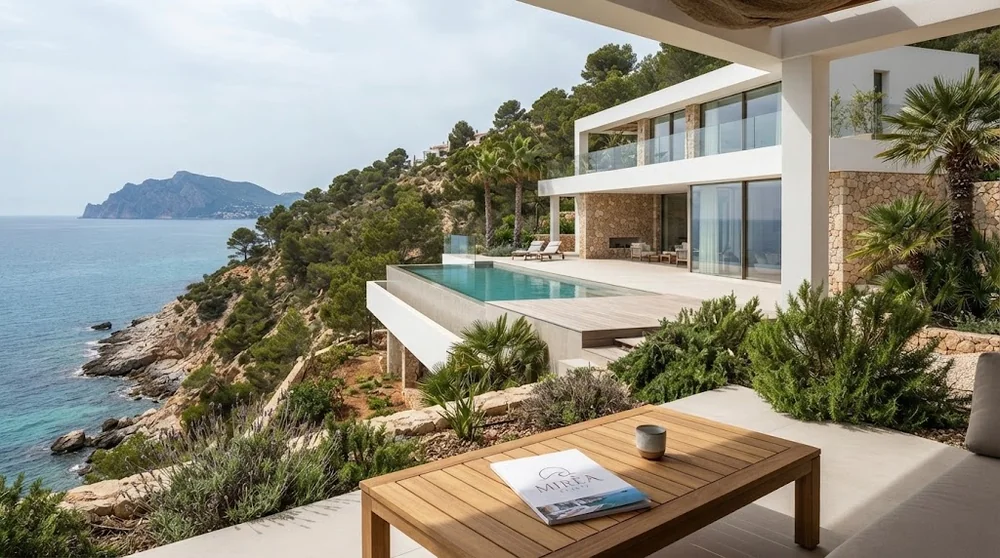
Altea is a town on the Costa Blanca known for its whitewashed old quarter and blue-domed church on a hill above the sea. Altea Hills is a residential development within the municipality, not the town itself, and buyers should not confuse the two when comparing properties or reading listings.
Altea Hills is a hillside development with controlled access, and its main draw is panoramic views over the Bay of Altea and towards Benidorm. Many owners value the sense of security and privacy that gated sections provide. Not every Altea villa is in a gated community, though: other villas sit on hillsides around the town, in smaller urbanisations or on independent rural plots with their own character and planning considerations.
The trade-offs are mostly about topography. Elevated developments involve steep roads, so access is by car for groceries, the beach and the old town. Community rules and fees apply in managed developments, and you should read them before buying. If you want to walk to cafés in the evening, a villa nearer the old town may suit you better, even if the view is narrower. Altea’s beaches are largely pebble, which some buyers love and others do not.
6. Begur: coves and privacy on the Costa Brava
Begur is a hilltop town on the Costa Brava in Catalonia, crowned by the ruins of its castle and known for streets of restored houses built by emigrants who returned from the Americas. The town itself sits inland and above the sea; the coves and most villa settings lie below and around it.
Its coastline includes several well-known coves, among them Aiguablava, with clear water and a small sandy beach, and Sa Riera, one of the larger beaches in the area. Villas are often set on pine-covered slopes overlooking these coves, which gives a strong sense of privacy and scenery that many buyers find hard to match elsewhere in Spain.
That same topography creates practical limits. Roads to the coves are narrow and winding, parking near beaches is restricted in summer, and seasonal demand is concentrated in July and August. Pine trees can frame a view beautifully but can also block it as they grow. In our experience, Girona–Costa Brava airport is usually the closer option and Barcelona the busier one with more routes, but journey times depend heavily on season, traffic and the exact address, so we do not quote fixed figures. Begur suits buyers prioritising landscape and summer use more than winter services.
7. Andratx: sea-view villas in southwest Mallorca
Andratx is both a municipality and an inland town in southwest Mallorca. Port d’Andratx is the municipality’s coastal harbour area, a few kilometres from the town, and it is where most luxury sea-view villas are concentrated. The municipality also includes other coastal areas such as Camp de Mar and Sant Elm.
Around Port d’Andratx, harbour-side homes offer the marina, restaurants and a walkable waterfront, while elevated villas on the surrounding slopes provide wide views over the bay and the sunset, with more privacy and usually more steps and steep driveways. Boat owners value the marina, though berth availability is a separate question from buying a villa.
Island living brings its own logistics. Palma airport is reached by car, and on many routes flight frequency drops outside the main season. In our team’s assessment, based on quotes clients have shared with us rather than official statistics, building, maintenance and contractor costs on Mallorca often run higher than on the mainland, and availability can be tighter. A mistake we often see with beachfront buyers: assuming an island harbour villa can be serviced on mainland timelines. Plan for longer lead times on works and repairs, and ask for local quotes early.
What does a luxury sea-view villa cost in Spain?
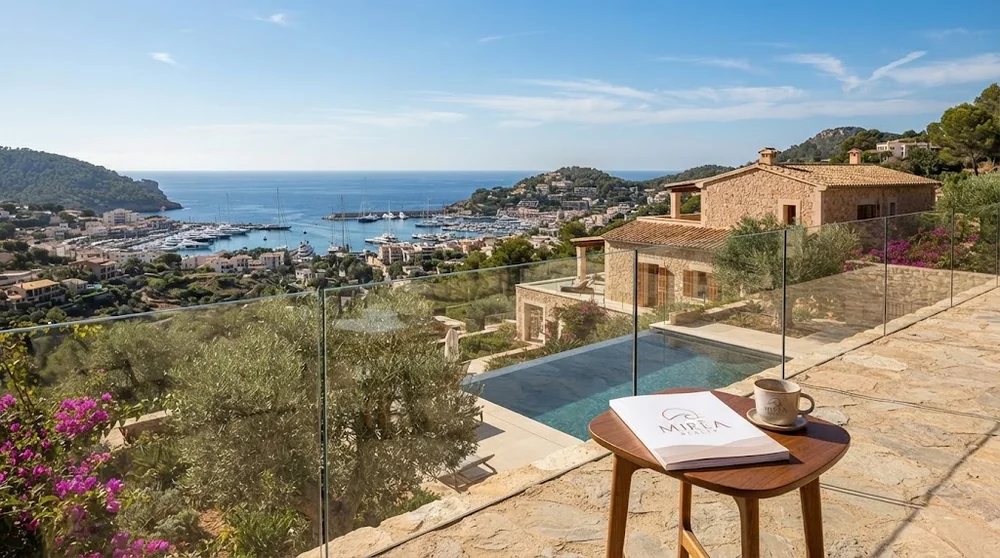
We want to be transparent here. For this edition (October 2026), the Mirea team did not compile a verified, comparable sample of at least three active detached sea-view villa listings per town with consistent criteria, so we are not publishing asking-price ranges for the seven towns. Publishing invented or unrepresentative ranges would do more harm than good, especially in markets where a single exceptional property can distort a small sample. When we can document such a sample, with its size, collection date and limitations, we will add a town-by-town table here.
Until then, the most useful thing we can do is explain which numbers to trust. Three different measures are often confused in property coverage:
| Price measure | What it shows | Why it can mislead villa buyers |
|---|---|---|
| Asking price | What a seller hopes to achieve on a listing | Can be above the final price; small samples are not representative |
| Completed sale price | The agreed transaction price documented in the sale deed | Public statistics built on these prices are usually aggregated and published with delays, and access to individual registry information is limited, so single villas are hard to compare |
| Town-wide average per m² | An average across apartments, townhouses and villas | Not a valuation of a luxury detached sea-view villa |
A municipality-wide average price per square metre is not a quote for a luxury sea-view villa. Plot size, view quality, orientation, condition, privacy and legal status can move a villa’s value far more than the town average suggests. The best evidence is a current set of genuinely comparable properties, ideally combined with an independent valuation.
Acquisition costs
The purchase price is only the starting point. As of October 2026, the main purchase tax on a resale property is the regional transfer tax (ITP), and rates differ by region:
- Andalusia (Marbella, Estepona): a general ITP rate of 7% (as of October 2026).
- Valencian Community (Moraira, Jávea, Altea): as of October 2026, the general ITP rate is 9% where the property value does not exceed €1 million; where its value exceeds €1 million, the applicable general rate is 11%. Exceptions may apply. The 9% rate follows Ley 5/2025 of the Generalitat Valenciana, effective for transactions from 1 June 2026.
- Catalonia (Begur): a progressive scale starting at 10% and reported to reach 13% at the highest values (as of October 2026).
- Balearic Islands (Andratx): a progressive scale from 8% reported to reach 13% at the highest values (as of October 2026).
- New builds from a developer: VAT, generally 10% for residential property under the Spanish VAT Law (Ley 37/1992), plus stamp duty (AJD) at the regional rate, instead of ITP (as of October 2026).
Budget separately for notary and land registry fees, independent legal fees, a technical survey, any mortgage costs and currency transfer costs. Reduced rates exist for specific buyer profiles, but they rarely apply to second homes bought by non-residents. Tax rates and the taxable base should be confirmed by a local tax adviser for your specific purchase before you sign.
Recurring ownership costs
From our work along the Spanish coast, running costs are where villa budgets most often slip. Rather than quoting averages that would not fit your plot, here is the framework we use with clients:
| Cost | When it is paid | What drives the amount | Who to ask |
|---|---|---|---|
| Local property tax (IBI) | Annually | Cadastral value and the town hall’s rate | Seller’s last receipts; town hall |
| Waste collection charge | Annually | Municipal ordinance | Seller’s receipts; town hall |
| Non-resident income tax | Annually, even if not rented | Cadastral value; rental income taxed separately | Tax adviser |
| Community fees | Monthly or quarterly | Development services, security, shared areas | Community administrator |
| Insurance | Annually | Rebuild value, location, cover | Insurer or broker |
| Pool, garden, irrigation, security | Ongoing | Plot size, specification, water use | Local maintenance companies |
| Repairs from salt air and sun | Ongoing | Exposure, materials, age of the house | Surveyor |
Non-resident owners are subject to Spanish non-resident income tax on the property under the Non-Residents Income Tax Law (Real Decreto Legislativo 5/2004), as of October 2026; the Spanish Tax Agency publishes current guidance and forms. Annual totals vary widely by plot and specification, so request recent receipts from the seller.
How to assess a sea view before buying
A view can be the largest single driver of a villa’s price, so it deserves a structured check rather than a first impression on a sunny afternoon. We always tell clients to check the following on site:
- Sightlines from the rooms that matter: stand in the living room, main bedroom, kitchen and pool terrace, not only on the roof terrace used for marketing photos.
- Orientation and light: note where the sun rises and sets, how much winter sun the terraces receive, and whether glare or wind affects outdoor living.
- Seasonal vegetation: pines, palms and hedges on your plot or next door can grow into the view; ask who owns them and whether they can be trimmed.
- Neighbouring plots: look for empty or under-built land below you and ask the town hall what can legally be built there and to what height.
- Planning permissions and zoning: request the planning status of your plot and nearby land, and check for pending licences or development plans.
- Slope and structure: steep plots may need retaining walls; ask a surveyor to inspect them and the drainage.
- The route to the beach: walk or drive it yourself, noting gradients, pavements, road crossings and summer parking.
- Noise and privacy: listen for roads, bars or marinas, and check whether neighbours overlook your terraces.
- Professional advice: commission an independent surveyor and lawyer for any purchase where the view is a key part of the price.
A view that is open today is not automatically protected in the future. Unless planning rules, the topography or a legally binding restriction prevent building below you, no listing can guarantee that the view will stay as it is. A seller’s assurance is not a legal protection.
Coastal law, title and holiday-rental checks
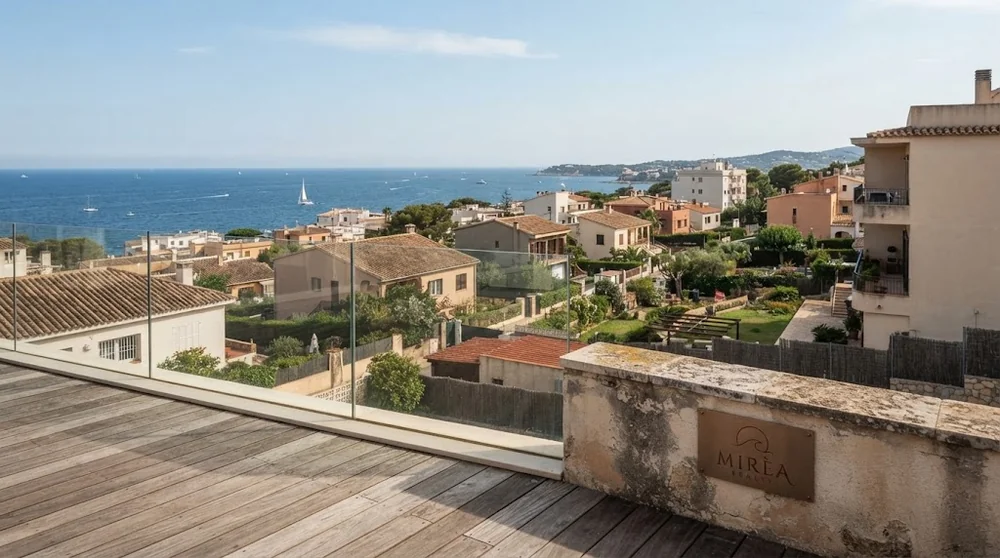
In our experience, many luxury sea-view villas in Spain sit on elevated land some distance from the shore, but some are close enough to be affected by the coastal legislation. A sea-view villa is not the same as a beachfront property, and the legal checks depend on where the plot sits relative to the legally defined coastline. Coastal-law implications must be checked against the official delimitation and the individual parcel, never inferred from a listing label.
How the Ley de Costas works
The Spanish Coastal Law (Ley 22/1988 de Costas, consolidated text) defines the maritime-terrestrial public domain, which belongs to the State, and sets easements on private land next to it. As of October 2026, the general rule in Article 23 is that the protection easement covers a 100-metre strip measured inland from the inner limit of the shoreline (ribera del mar) as fixed in the official coastal delimitation (deslinde), not from the water’s edge or from your front door. Residential construction is generally prohibited within that strip.
Transitional provisions can change the position. Land that was formally classified as urban when the law entered into force in July 1988 may be subject to a reduced 20-metre protection easement, and existing buildings in affected zones can be subject to specific regimes. Whether any of this applies depends on the exact parcel, its planning history and the approved delimitation. A mistake we often see with beachfront buyers: relying on a map in a sales brochure instead of the official delimitation.
Checks to ask your lawyer for
- The official coastal delimitation and any easements affecting the plot.
- A current land registry extract (nota simple), which identifies the registered owner and registered charges such as mortgages or embargoes.
- Separate evidence that community fees, local taxes (IBI) and utilities are paid up to date, since these and other unregistered liabilities do not necessarily appear in the nota simple.
- The cadastral record, compared with the registry and the physical reality of the house, pool and extensions; it can be consulted through the Spanish Cadastre’s electronic office.
- The planning status of the plot and confirmation that buildings, pools and extensions are licensed.
- The first-occupation or habitability documentation required in the region.
- Community rules and debts in managed developments.
Many of these checks are technical, and the right questions depend on your nationality, residency plans and the specific property. If you are weighing a particular villa and want a second opinion on what to ask before paying a deposit, a direct conversation often saves weeks of back-and-forth.
Have a specific coastal property in mind and questions about the legal steps or the Ley de Costas position? Send us a message and the Mirea team will help you work out what to check first.
We can explain the process and coordinate with local professionals, but formal legal opinions on title, planning and coastal status should always come from an independent Spanish lawyer acting only for you.
Holiday-rental registration and licensing
Holiday-rental rules in Spain have several layers, and they changed significantly in 2026. Royal Decree 1312/2024 created a national single rental registration procedure, which became mandatory for listing short-term rentals on online platforms from July 2025. In May 2026, the Supreme Court partly annulled that Royal Decree, holding that the State lacked competence to impose the national registration procedure; the rulings were published in the Official State Gazette in June 2026 (Supreme Court judgment published in the BOE). As reported in October 2026, the provisions on the national digital single window for platform data sharing remain in force. The original 2025 national registration regime should therefore not be presented as unchanged.
Regional, municipal and community requirements are a separate layer, must be checked separately and may continue to apply. Each region regulates tourist rentals through its own registration or licence system, towns can restrict them through planning rules, and Andalusia, the Valencian Community, Catalonia and the Balearic Islands each run their own procedures. In our experience, the Balearics is among the most restrictive regions for new tourist-rental places, but limits change, so treat that as an observation rather than a rule. Community statutes in some developments can also restrict holiday lets. Check the current regional, municipal and community position, and any measures adopted after the 2026 rulings, for the specific villa, and have it confirmed in writing before buying for rental use.
Which coastal town should you shortlist?
There is no universal winner, only a better match for your priorities. In our team’s assessment, the seven towns line up like this:
- Year-round services: Marbella first, with Estepona as a calmer alternative on the same coast and airport.
- Quieter coves and residential life: Moraira and Jávea, accepting seasonality and car dependence.
- Elevated panoramic views: Altea, especially in hillside developments, if steep access does not trouble you.
- Costa Brava scenery: Begur, for buyers who prioritise landscape and summer use.
- An island setting: Andratx, for harbour life and Mallorca’s southwest coast, with island logistics.
Each choice involves trade-offs between view, walkability, privacy, services and cost. A buyer who plans to spend winters in Spain will weigh healthcare access and open restaurants very differently from a family who visits every August. A shortlist works best when it starts from your budget, preferred coast, intended use and the type of view and access you need, rather than from a town name.
Tell us your budget, your preferred coast, how you plan to use the villa and what matters most about the view and access, and we will prepare a tailored shortlist.
A shortlist is a starting point for viewings, not a commitment. We do not promise particular returns, and availability changes constantly, so every property should still be judged on its own view, paperwork and running costs.
Frequently asked questions
Where are the best places to buy a luxury sea-view villa in Spain?
Marbella, Estepona, Moraira, Jávea, Altea, Begur and Andratx offer distinct options for buyers seeking a luxury villa with a sea view. The right choice depends on budget, access, climate, privacy and how often you plan to use the home. Compare individual plots as well as towns: a view does not necessarily mean direct beach access.
Which Spanish coastal town is best for year-round living?
Marbella is a strong option for year-round living because it offers established services, an international community and access to Málaga airport. Estepona, Jávea and other towns can also work well, depending on your needs. Before choosing, check the property’s actual travel time to healthcare, schools, shops and other services you use regularly.
Is Marbella or the Costa Blanca better for a luxury villa?
Marbella may suit buyers who value an established luxury market and a wide choice of year-round services. Moraira, Jávea and Altea on the Costa Blanca may appeal to buyers who prefer quieter residential areas and coves. Compare specific properties on price, view, privacy and access; neither coast is automatically cheaper or better for every buyer.
How much does a sea-view villa cost in Spain?
The price of a sea-view villa in Spain varies greatly by town, neighbourhood, plot, view, condition and proximity to the coast. As of October 2026 we do not publish town price ranges because we have not compiled a verified comparable sample. A municipal average price per square metre is not a reliable quote for a luxury detached villa. Request a current selection of comparable properties and budget separately for purchase taxes and ongoing ownership expenses.
Can foreigners buy a coastal villa in Spain?
Foreign buyers can generally purchase property in Spain, but the legal checks depend on the property and buyer’s circumstances. Before paying a deposit, ask an independent Spanish lawyer to review title, planning status, registered charges, unpaid fees and taxes, and any coastal restrictions. Some properties or buyers may face additional requirements, so obtain advice for the specific transaction.
Can I rent out a luxury villa in Spain to holidaymakers?
A luxury villa may be eligible for holiday rental, but eligibility depends on its location, property status and applicable regional, municipal and community rules. National registration requirements changed after Supreme Court rulings in May 2026 and do not replace other permissions. Verify the current requirements with the relevant authorities and a local specialist before buying for rental use.
Conclusion
Marbella, Estepona, Moraira, Jávea, Altea, Begur and Andratx each offer something different, from Marbella’s year-round services to the coves of Begur and the harbour life of Port d’Andratx. The town sets the lifestyle, but the value of a sea-view villa depends heavily on the specific property and plot, as well as market conditions: its sightlines, slope, orientation, route to the beach and legal status all count.
From our work along the Spanish coast, the buyers who end up happiest are those who separate the view, the beach access and the frontline position from the start, budget for the full cost of ownership, and let an independent lawyer check coastal, title and planning issues before any deposit. Rental plans deserve the same caution, especially after the 2026 changes to national registration.
Start with your priorities, compare a small number of genuinely suitable properties, and visit at the times of day and year you will actually use the house. A sea view is a pleasure every morning, as long as you have checked what supports it.
Disclaimer: This article is general information prepared by the Mirea team as of October 2026. It is not individual legal, tax or financial advice. Laws, tax rates and rental rules change, and their application depends on the specific property and buyer. Consult an independent Spanish lawyer, tax adviser and other relevant specialists before making any decision.
 Real estate in Georgia
 Real estate in Montenegro
 Real estate in Cyprus
 Real estate in the UAE
 Bali Real Estate
 Real estate in Thailand
 Real estate in Saudi Arabia
 Real estate in Turkey
 Real estate in Zanzibar
 +34 611 898 442
 hello@property-spain.es
 Spain


 Get catalogue of TOP-7 objects