
 +34 611 898 442


Choosing between a luxury and an affordable coastal home in Spain is rarely a question of taste alone. It is a decision about how much of your budget goes into location and prestige, how much goes into space, and how much you can comfortably keep aside for taxes, maintenance and the unexpected. The same €500,000 can buy a compact frontline flat in one town and a large family home forty minutes down the coast.
Luxury coastal property in Spain offers prestigious locations, privacy and premium amenities, while affordable homes generally provide more space for the same budget. Marbella, Mallorca and Ibiza dominate established luxury markets; Torrevieja, parts of Costa Cálida and less expensive coastal towns offer lower entry prices. The right choice depends on your total budget, intended use, running costs and resale prospects.

Luxury vs Affordable Coastal Property: Key Differences
Luxury and affordable are not fixed national categories in Spanish coastal property. A home is luxury or affordable relative to its local market, its build standard and the buyer’s own finances. A €700,000 apartment can be premium stock in Torrevieja and an ordinary two-bedroom flat in Santa Eulària des Riu. For that reason, the Mirea team uses one consistent framework for every coast, from the Costa del Sol to the Canary Islands, rather than a single national price line.
What makes a coastal home luxury?
A luxury coastal home in Spain usually combines scarce location, privacy and build quality that the local market cannot easily replicate. Scarcity can mean frontline beach position, an unobstructed panoramic view, a gated estate with security, or walking access to a marina and year-round restaurants. Build quality shows in insulation, glazing, waterproofing, lift and pool engineering, and the quality of the community or estate management. Luxury also brings heavier obligations: larger plots, pools, gardens, security systems and higher insurance values all raise annual costs.
What does affordable mean in 2026?
An affordable coastal home in Spain in 2026 is one that the buyer can purchase, run and repair without financial strain, in a location that still meets their practical needs. Affordable stock is often older apartments, townhouses in established urbanisations, or homes a short drive from the beach. Lower entry prices can come with compromises: older lifts and plumbing, smaller communal budgets, seasonal ghost-town effects in winter or more car dependence.
To compare markets consistently, we use four non-official, illustrative editorial price bands. These bands are practical comparison tools, not legal or statistical classifications.
| Illustrative band (advertised price) | Typical coastal stock | Space for the money | Location quality | Amenities and maintenance | Resale buyer pool |
|---|---|---|---|---|---|
| Accessible: below €300,000 | Older apartments, bungalows, townhouses in established urbanisations | Highest in lower-cost municipalities; small in prime towns | Often walking or short driving distance to the beach | Shared pools; modest community fees; older building systems | Broad: retirees, second-home buyers, local buyers, investors |
| Mid-market: €300,000–€750,000 | Newer apartments, penthouses, semi-detached homes, small villas in cheaper areas | Good balance of space and location | Sea views or beach proximity become realistic | Better communal facilities; moderate fees | Broad and international |
| Premium: €750,000–€1.5 million | Frontline apartments, modern villas, prime penthouses | Varies sharply by micro-market | Strong positions in prime towns | Private pools or high-spec communities; higher running costs | Narrower, mostly international |
| Luxury: above €1.5 million | Large villas, gated-estate homes, frontline penthouses, island fincas | Space plus privacy, priced at a scarcity premium | Scarce positions: beachfront, panoramic hillside, gated estates | Significant staff, garden, pool, security and repair budgets | Smallest; buyers are selective and price-sensitive |
Here’s what that means in practice: the useful question is not “which band am I in?” but “what does each extra euro buy in this specific micro-market, and can I sustain the running costs that come with it?”
Spanish Coastal Property Prices in 2026
Spanish coastal property prices in 2026 vary more within regions than between them. We have deliberately not published a table of exact price-per-square-metre figures in this guide. The most widely quoted coastal figures come from private listing portals and valuation companies, and we have not been able to match them to an eligible official publication with the same method, geography and date. Rather than present unverified numbers as fact, we explain where prices tend to sit and how to read any figure you are shown.
Where coastal prices are highest
In our professional assessment, the highest coastal prices in Spain are concentrated in the Balearic Islands, especially Ibiza and Mallorca’s southwest (Calvià, including Portals Nous and Bendinat, and Andratx), and in prime Costa del Sol municipalities such as Marbella and Benahavís. Prime parts of Begur on the Costa Brava, frontline Calpe and southwest Tenerife’s resort coast also trade well above the averages of their wider provinces.
Where buyers get more for their budget
Lower entry prices are generally found on the southern Costa Blanca, around Torrevieja and Orihuela Costa, and in Murcia’s Costa Cálida. Averages hide wide neighbourhood differences, though: the best frontline buildings in a “cheap” town can cost more than ordinary flats in a “prime” one. Any regional label needs checking at municipality and street level, with dated comparable evidence.
Why market statistics disagree
Different Spanish property statistics measure different things, so two honest figures for the same place can differ substantially. Before relying on any number, check which of the following it is.
| Type of figure | What it measures | Typical geography | Best used for | Main limitation |
|---|---|---|---|---|
| Listing-portal asking prices (e.g. Idealista, Fotocasa) | What sellers hope to achieve on currently listed stock | Province, municipality, sometimes district | Spotting direction and relative expense | Not sale prices; depends on what happens to be listed |
| Valuation statistics (e.g. Tinsa, appraisal-based official series) | Appraisers’ assessments, often for mortgage lending | Province, larger municipalities | Broader, smoother trends | Includes ordinary inland homes; lags the market |
| Notarial transaction statistics | Prices declared in signed deeds | Province, municipality | What buyers actually paid | Published with delay; mixes all property types |
| INE Housing Price Index | Percentage change in transaction prices | National and regional | Measuring price change over time | Gives no euro-per-square-metre level |
| Recent comparable sales | Sales of similar homes nearby | Building or street | Pricing a specific purchase | Needs careful matching on size, condition and view |
Two rules follow. Never average figures produced by different methods or in different periods, and never read a provincial figure as a beachfront price: a frontline penthouse on the Marbella Golden Mile and an inland village house both sit inside “Málaga province”. When a percentage gap between two areas is quoted, check the denominator too: one area being a certain percentage above another is not the same as the second being that percentage cheaper.
Best Coastal Locations for Luxury Buyers
Spain’s luxury coastal markets differ less in price than in daily experience: how private the home feels, how far the airport is, and whether the neighbourhood is alive in February. From our work along the Spanish coast, we separate three luxury formats that are often confused: true seafront homes, hillside panoramic villas, and inland gated estates with distant sea views.
Marbella, Golden Mile and Benahavís
The Marbella Golden Mile is the stretch between Marbella town and Puerto Banús, combining beachfront apartments, gated villa communities and some of the Costa del Sol’s most established addresses. Its strengths are walkability to restaurants, beach clubs and the town, plus Málaga airport roughly 45–60 minutes away by car depending on traffic. Its drawbacks are summer congestion, noise near the A-7 and AP-7 corridors, and prices that reflect the address as much as the building. Puerto Banús offers marina life and nightlife, which some owners love and others find tiring in August. Nueva Andalucía, behind Puerto Banús, offers golf-valley villas and apartments with more space per euro but more car dependence. Sierra Blanca, above the Golden Mile, is a gated hillside estate valued for security and views close to town. La Zagaleta in Benahavís is a large private estate with extensive security and plots; it delivers exceptional privacy, but daily errands mean driving, and the buyer pool for very large homes is narrow.
Mallorca and Ibiza
Mallorca’s southwest luxury belt includes Bendinat, Portals Nous and Andratx, all within easy reach of Palma and its international airport. Mallorca works year-round better than many island markets because Palma provides hospitals, international schools and winter culture. Ibiza’s luxury market is more seasonal: summer is intense, and some villages become quiet from November to March. Island ownership brings practical costs, including higher construction and repair prices, contractor scarcity in peak season and limited new building land.
Holiday letting is the other island reality. As of October 2026, official Balearic government material states that new tourist accommodation places cannot be created in multi-family residential buildings, and island councils and municipalities add their own zoning limits. We always tell clients to check whether the specific property already holds a valid tourist-letting authorisation, what island rules apply to it, and whether that authorisation survives a sale, before including any holiday income in their budget.
Costa Brava, Sitges and Barcelona waterfront
The prime Costa Brava, especially Begur, Calella de Palafrugell and Cadaqués, appeals to buyers seeking architectural character, coves and pine-covered headlands rather than a resort lifestyle. Winters are cooler and wetter than in Andalusia, and many villages are distinctly seasonal. Girona and Barcelona airports serve the area. Sitges, around 40 minutes from Barcelona, offers a walkable year-round town, train links and a strong international community. Barcelona’s waterfront suits buyers who want city services first and beach second.
Prime Canary Islands and Sotogrande
Sotogrande, in Cádiz province at the western end of the Costa del Sol, is a low-density planned community built around golf, polo and a marina; it is calm and green but car-dependent and quieter in winter. In the Canary Islands, premium submarkets in southwest Tenerife, such as the Costa Adeje resort coast, offer a mild climate year-round and frequent European flights. Distance from mainland Spain and the separate Canary tax system are the trade-offs.
The Mirea team’s view: a higher price buys scarcity, not immunity. Luxury homes still need legal checks, still depend on local demand and can take longer to sell because fewer buyers can afford them.

If you want to see how Spain’s luxury coastal market has performed since 2007, our market history looks at Marbella, Mallorca and Ibiza through the 2008 crash and the recovery that followed.
Best Affordable Coastal Property Markets in Spain
Affordable coastal property in Spain does not usually mean affordable beachfront. Even in lower-cost municipalities, the best frontline buildings can cost far more than the town average, while the true value is often found a few streets or a few kilometres back. No coastal region is uniformly cheap, and every apparent bargain needs a check on condition, services and flood exposure.
Costa Blanca South
Torrevieja offers a large stock of apartments and bungalows, many built between the 1980s and 2000s, with an established international community, shops and services that continue through winter. Older stock can need new kitchens, bathrooms, electrics, air conditioning and window replacement, so we always tell clients to check the age of the lift, roof and plumbing before comparing prices. Orihuela Costa, including areas around Playa Flamenca and Cabo Roig, offers urbanisations with communal pools; some areas are lively year-round while others empty after summer. Guardamar del Segura is a quieter town with pine-backed dunes. Santa Pola has a working fishing port and a more Spanish everyday character. Alicante-Elche airport is typically 20–45 minutes away by car from these towns. Parts of the Vega Baja area, including low-lying zones near the Segura river, have experienced serious flooding, notably during the DANA of September 2019, so flood-map checks are essential.
Costa Cálida and western Costa del Sol
In Murcia’s Costa Cálida, Mazarrón and Águilas offer quieter coastal living with generally lower entry prices than the Costa del Sol, although direct comparisons need dated municipal evidence. Both towns can feel seasonal in parts, and hospital access and flight connections (via Región de Murcia International Airport or Alicante) require more driving. Cartagena offers a genuine city with year-round services and a historic centre near beaches at La Manga and Cabo de Palos. On the western Costa del Sol, Manilva and Casares have traditionally offered lower entry points than Marbella or Estepona, but this is relative value within an expensive coast; frontline and new-build stock there can still be costly.
Other value-oriented Spanish coastal markets
The Costa Dorada around Tarragona, parts of the Costa de la Luz in Huelva and Cádiz, and the northern Atlantic coast offer further alternatives for buyers who accept cooler winters, windier summers or longer journeys to international airports. Request current dated evidence before assuming lower prices.
A mistake we often see with beachfront buyers: comparing only the purchase price. In an affordable urbanisation, the real costs can be community levies (derramas) for roof or façade repairs, the drive to a hospital in winter, or a remote development where services close in October.

What Different Coastal Property Budgets Buy
The table below is an editorial assessment based on the stock our team commonly sees advertised, not verified market availability. All amounts are advertised purchase prices excluding taxes, fees and renovation. We have deliberately not converted average prices into floor areas: municipal averages are dominated by apartments, so dividing a budget by an average says nothing reliable about villas, frontline homes or whether a given configuration exists at that price today.
| Advertised budget | Lower-cost coastal municipalities (e.g. Torrevieja, Orihuela Costa) | Prime municipalities (e.g. Marbella, Calvià) | What to verify (editorial assessment) |
|---|---|---|---|
| €200,000 | Resale apartments and bungalows often appear, frequently older and in need of updating | Very limited: mainly small, older or less central units | Building condition, lift, renovation cost, sea views (rare) |
| €350,000 | A wider choice of resale apartments and townhouses | Mostly smaller apartments, usually away from the front | Space versus location becomes the key choice |
| €500,000 | Newer apartments and some larger homes may come into range | Mid-sized apartments in established areas | Community fees, communal facilities, true walking distance |
| €750,000 | Upper end of the local market in many areas | Larger apartments or townhouses; frontline rare | Whether comparable homes have actually sold at this level locally |
| €1,000,000 and above | Few local buyers at this level; check that comparable sales exist at all | Premium apartments and, at higher budgets, villas in established areas | Resale pool, running costs, privacy and security needs |
Here’s what that means in practice: a home priced far above the local norm in a lower-cost municipality may take longer to sell than a similarly priced home in a market where many buyers spend at that level. Before committing a large budget anywhere, ask for recent comparable sales, not just asking prices.
How to compare two apparently similar coastal homes
Two coastal homes advertised at the same price per square metre may not be comparable. Spanish listings often quote built area (superficie construida), which can include walls, terraces and a share of communal areas, while usable area (superficie útil) is the internal floor space. Compare usable to usable. Check orientation (south and southeast generally receive more winter sun), the actual walking route to the beach, building age and condition, lift access, parking, and whether the registered and cadastral descriptions match the physical property. A cheaper home that needs €60,000 of renovation and has an unregistered extension may cost more in the end than the better-documented alternative.
Once you have a budget in mind, the next question is the type of home it should buy. Our guide to villa or apartment on the Spanish coast compares the costs, rules and responsibilities that come with each.
Purchase Taxes and Five-Year Ownership Costs
Spanish coastal purchase costs depend on whether the home is new or resale and on the autonomous community. As of October 2026, there is no single Spain-wide resale tax rate.
Taxes and completion costs
Under the Spanish VAT Law (Ley 37/1992), qualifying first supplies of new residential property in the common VAT territory generally attract 10% IVA (Impuesto sobre el Valor Añadido, Spanish VAT), plus regional AJD (Actos Jurídicos Documentados, stamp duty on the notarised deed). Resale homes usually attract regional ITP (Impuesto sobre Transmisiones Patrimoniales, transfer tax) instead of IVA, governed by the consolidated ITPAJD Law (Real Decreto Legislativo 1/1993). The Canary Islands do not apply IVA; they use IGIC (Impuesto General Indirecto Canario), and buyers there should confirm the applicable IGIC or ITP treatment with a local tax adviser.
The ITP taxable base is not automatically the price you agree. Under Article 10 of that law, the base for a resale home is generally the higher of the declared value and the property’s cadastral reference value (valor de referencia), where one exists. Buyers should check the reference value before calculating ITP.
As of October 2026, selected regional resale ITP rates include the following, subject to reduced rates for qualifying residents and specific conditions:
- Valencian Community (Costa Blanca): 9% general rate for purchases from 1 June 2026, reduced from 10% by regional Ley 5/2025. Where the property’s value exceeds €1 million, the applicable rate on the whole transfer becomes 11%; it is not a marginal slice applied only to the amount above €1 million. The general AJD rate moved to 1.4% on the same date.
- Andalusia (Costa del Sol): a flat 7% general resale ITP rate.
- Balearic Islands: a progressive scale from 8% to 13%, with the lowest rate for the lowest value band and the highest for the most expensive homes.
- Murcia, Catalonia and the Canary Islands: each applies its own rates; confirm the current rate and any value bands with a tax adviser before signing.
Completion costs also include notary fees, registration at the Registro de la Propiedad (Land Registry), independent legal fees, a technical survey and, where relevant, mortgage valuation and arrangement costs. Notary and registry charges follow regulated tariffs; legal fees are agreed with your lawyer. From reservation to completion, resale purchases commonly take several weeks to a few months, depending on financing, documentation and the buyer’s NIE (foreigner identification number).
Running costs of affordable apartments and luxury villas
Annual coastal ownership costs in Spain include IBI (municipal property tax), rubbish collection charges, community fees, insurance, utilities, repairs, pool and garden care and, for absent owners, property management. Non-resident owners who do not let the property generally file an annual non-resident income tax return on an imputed income based on cadastral value; a tax adviser should calculate this.
A five-year ownership-cost example
The model below is entirely hypothetical. Tax figures apply the regional rates above to resale purchases and assume the taxable base equals the illustrated price, with no higher cadastral reference value. Every other figure is an editorial assumption, not a quote or an actual bill. It excludes mortgage costs, non-resident income tax and the opportunity cost of capital.
| Item (hypothetical, resale) | €300,000 apartment, Costa Blanca (ITP 9%) | €600,000 apartment, Costa del Sol (ITP 7%) | €1,500,000 villa, Marbella (ITP 7%) |
|---|---|---|---|
| Transfer tax (ITP) | €27,000 | €42,000 | €105,000 |
| Notary and registry (assumed) | €2,500 | €3,000 | €4,500 |
| Independent legal fees (assumed ≈1%) | €3,000 | €6,000 | €15,000 |
| Technical survey (assumed) | €600 | €900 | €1,500 |
| Initial costs on top of price | €33,100 | €51,900 | €126,000 |
| Annual recurring costs (assumed; breakdown below) | €5,650 | €11,500 | €35,200 |
| Five years of recurring costs | €28,250 | €57,500 | €176,000 |
| Major maintenance allowance over five years (assumed: levies, roof, pool equipment, waterproofing) | €8,000 | €15,000 | €45,000 |
| Five-year total excluding purchase price | €69,350 | €124,400 | €347,000 |
Assumed annual breakdown for owner use: €300,000 apartment — IBI €600, community €1,800, insurance €350, utilities €1,500, routine repairs €600, key-holding and management €800. €600,000 apartment — IBI €1,100, community €3,600, insurance €600, utilities €2,000, routine repairs €1,200, management €3,000. €1,500,000 villa — IBI €4,500, estate fees €3,000, insurance €3,200, utilities €7,500, routine repairs €5,000, pool and garden €6,000, management and security €6,000. Routine repairs are separate from the major maintenance allowance.
In this hypothetical model, the villa’s five-year costs outside the price are roughly five times the €300,000 apartment’s, yet both come to about 23% of the price. The proportion looks similar, but the absolute cash needed is very different, and villa repair bills tend to arrive as large single items rather than spread-out fees.
One fixed budget, three regions
The table above changes the budget as well as the region. To isolate the regional effect, the hypothetical comparison below starts from the same all-in budget of €400,000 (price plus purchase costs) for a comparable resale two-bedroom apartment in a community with a pool, used as a second home. It applies the same assumptions: taxable base equals price, legal fees ≈1%, notary and registry €2,500, survey €600. The Balearic case assumes the price falls within the lowest band of the scale (8%).
| Hypothetical item (all-in budget €400,000) | Costa Blanca (ITP 9%) | Costa del Sol (ITP 7%) | Mallorca, Balearic Islands (ITP 8%) |
|---|---|---|---|
| Available purchase price | ≈ €360,800 | ≈ €367,500 | ≈ €364,100 |
| ITP | ≈ €32,470 | ≈ €25,725 | ≈ €29,130 |
| Legal, notary, registry and survey | ≈ €6,710 | ≈ €6,775 | ≈ €6,740 |
| Annual costs: IBI / community / insurance / utilities / routine repairs / management | €500 / €1,800 / €350 / €1,500 / €600 / €1,200 = €5,950 | €700 / €2,400 / €400 / €1,600 / €700 / €1,500 = €7,300 | €650 / €2,200 / €450 / €1,700 / €900 / €1,500 = €7,400 |
| Five years of recurring costs | €29,750 | €36,500 | €37,000 |
| Major maintenance allowance (five years) | €8,000 | €8,000 | €9,000 |
| Five-year cash requirement (budget + running costs) | €437,750 | €444,500 | €446,000 |
Here’s what that means in practice: the tax difference between regions is real but modest at this budget, while what the purchase price actually buys differs far more from coast to coast. The same €364,000 to €368,000 typically secures more space or a better position on the Costa Blanca than in Mallorca, and island repair work tends to cost more. Treat all figures as illustrations to adapt with your adviser.
Is Paying More for a Sea View Worth It?
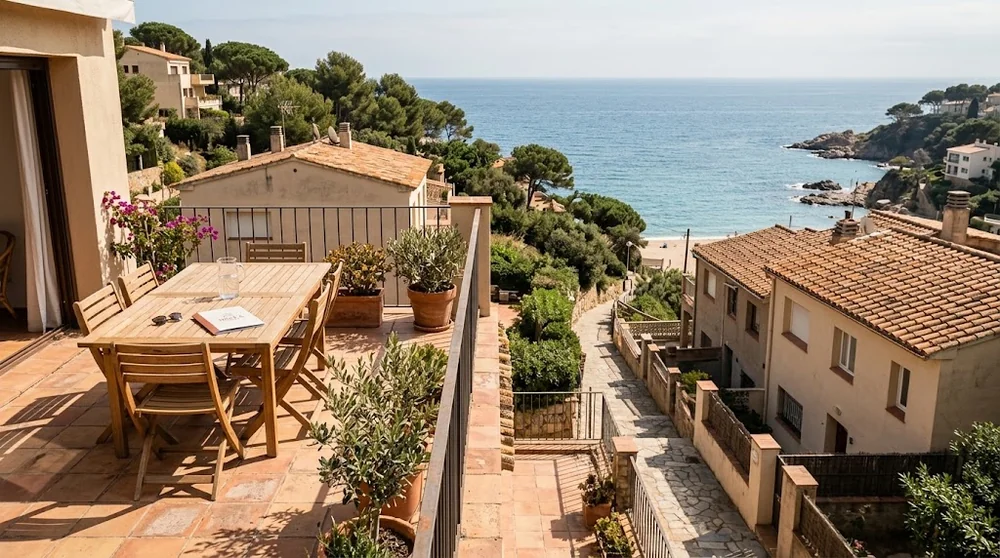
A sea view is priced in — here’s how to judge if it’s worth it. Spanish listings use terms loosely, so define what you are paying for. Frontline (primera línea) usually means no building or road between the property and the beach or promenade. Direct beach access means a private or communal path straight to the sand. A partial sea view is a slice between buildings; a panoramic view is broad and typically elevated, often from a hillside. Walking distance should be measured on the real route, including stairs, steep roads and busy crossings.
A sea-view premium can only be estimated with matched comparisons: two homes in the same area, of similar size, age, condition and layout, where the main difference is the view or access. Comparing a renovated frontline flat with an unrenovated inland flat tells you nothing about the view itself. Consider what can change: an empty plot in front may be buildable under the local plan, and a view can be lost. Frontline homes also face salt corrosion on railings, air-conditioning units and window frames, wind on terraces, summer noise and less privacy from the promenade.
Hypothetical example: two homes are advertised at the same price in the same Costa del Sol town. Home A is a two-bedroom frontline apartment with a panoramic view, a shared garage and a 1980s building that will need façade work. Home B is a three-bedroom apartment 600 metres from the beach on flat ground, with a partial sea view, private parking and a newer building. For a retired couple living there year-round, Home B may offer more daily utility; for a short-stay second home, Home A’s position may matter more.
- Define the view type and access precisely: frontline, direct access, partial, panoramic or walking distance.
- Walk the actual route to the beach and time it, including slopes and stairs.
- Check the local plan for buildable plots that could block the view.
- Confirm orientation and terrace usability in wind, summer sun and winter.
- Inspect salt damage on metalwork, frames, balconies and machinery.
- Assess parking, noise and privacy at peak season.
- Compare at least two matched properties to estimate the premium.
- Decide whether the premium matches how often you will actually use the view.
Coastal Law, Ownership and Property Risks
Buying coastal property in Spain requires legal and physical checks that inland purchases may not need. The right to buy a property does not automatically include the right to extend it, rebuild it, rent it to tourists or carry out major works.
Ley de Costas and beachfront restrictions
As of October 2026, Spain’s Ley 22/1988 de Costas (the Coastal Law), as amended including by Ley 2/2013, governs the dominio público marítimo-terrestre, the public maritime-terrestrial domain covering beaches, the shoreline and certain adjacent land. The boundary of that public domain is fixed through an administrative process called the deslinde. The law establishes easements on private land next to the public domain, including a transit easement for public passage and a general protection easement of 100 metres from the inner boundary of the shore, which may be reduced to 20 metres in certain land that was already classified as urban when the law came into force, under transitional rules. Within these zones, uses and works can be restricted or require authorisation.
Proximity to the sea does not in itself mean a property is illegal. Many coastal homes were lawfully built before 1988 or under exceptions, and their status depends on documents, dates and the specific deslinde. Where a building occupies land that falls within the public domain, the occupant may hold an administrative concession rather than full private ownership, and that changes what you are actually buying.
Legal and physical checks before buying
From our work along the Spanish coast, the documentary trail matters as much as the view. We always tell clients to check that the land registry, the cadastre and the physical property describe the same home.
- Obtain a current nota simple from the Registro de la Propiedad (Land Registry) to confirm ownership, charges, mortgages and encumbrances.
- Compare the registered description with the cadastral record (Catastro) for area, boundaries and use.
- Ask the town hall about planning status, building licences, first-occupation or occupancy documentation and any open infringement proceedings.
- Check whether the property is affected by a Ley de Costas deslinde or easement.
- Establish whether the asset is privately owned or held under a coastal concession; if a concession, check its remaining term, transfer conditions, permitted works and required administrative approvals.
- Review community of owners’ minutes, statutes and accounts for unpaid levies, planned works and rules on letting.
- Confirm IBI and community fees are paid up to date.
- Commission an independent technical inspection of structure, damp, waterproofing and services.
- Review insurance cover, including exclusions for flooding and storm damage.
Have a question about a beachfront property’s documents, coastal-law position or the next legal step? Send the Mirea team a message and we will explain what to request from your independent lawyer.
We can explain the process and organise documents and viewings, but legal conclusions about a specific property must always come from your own independent Spanish property lawyer.
Climate, flooding and building condition
Coastal homes in Spain face erosion, storm surges, intense rainfall episodes and salt corrosion. Check official flood-risk maps for the location, ask about past flooding in the building, inspect drainage in garages and basements, and look for rust in balcony reinforcement, which can cause concrete to crack. Ground-floor and garage-level homes in low-lying areas deserve particular scrutiny. Waterproofing, roofs and exterior metalwork need more frequent maintenance near the sea than inland.

Rental Potential and Resale: Luxury vs Affordable
Rental income from Spanish coastal property is never guaranteed, and the right to let depends on regional law, municipal rules and the building’s community. Owners generally choose between long-term rental, private use, legal short-term holiday letting, or a mix.
Rental demand and licensing
A Vivienda de Uso Turístico (VUT) is a home registered for short-term tourist letting under regional rules. As of October 2026, buyers should treat four layers as separate checks.
Regional. The autonomous community requires registration in its tourism register, and regions such as Andalusia, the Valencian Community, the Balearic Islands and the Canary Islands have tightened conditions in recent years. In the Balearic Islands, new tourist accommodation places in multi-family residential buildings are prohibited, as noted above.
Municipal. Town halls can limit or suspend new VUT registrations in particular zones.
Community of owners. In buildings subject to horizontal-property rules, since 3 April 2025 the reformed Horizontal Property Law (Ley 49/1960) requires express approval for a new tourist-letting activity by three-fifths of all owners who also represent three-fifths of the participation shares. Homes already lawfully operating as tourist lets before that date are generally treated differently from new activity, but their status should be confirmed with a lawyer.
National. Royal Decree 1312/2024 created a single national register for short-term rentals, and from 1 July 2025 listings on platforms were expected to show a registration number obtained through the Property Registry or Movable Property Registry. A Supreme Court judgment of 19 May 2026, published on 8 June 2026, annulled the provisions governing that registration procedure and the obligation to obtain the number through those registries; the consolidated text of the Royal Decree records the annulments. The digital single window and the framework for data exchange with online platforms remain in the consolidated text. As of October 2026, we have not identified replacement legislation reinstating a registry-based number, so ask your lawyer which national obligations currently apply before listing.
A VUT licence should never be assumed to be obtainable or transferable with a purchase.
Gross versus net rental returns
Gross rent is income before costs. Net operating income deducts vacancy, management, community fees, IBI, insurance and maintenance. Taxable income, financing costs and capital appreciation are separate questions. The examples below are hypothetical, start from the same annual cost assumptions as the five-year model and exclude income tax, mortgages and the major maintenance allowance.
How the fixed costs reconcile: for the €300,000 apartment, the owner-use total of €5,650 falls to €3,350 because the long-term tenant pays utilities (−€1,500) and the €800 key-holding fee is replaced by an 8% letting-management fee charged on rent actually collected. For the villa, the owner-use total of €35,200 falls to €29,200 because the €6,000 management and security budget is replaced by a 25% platform and management fee on gross rent; the owner still pays utilities in a holiday let.
| Hypothetical scenario | €300,000 apartment, long-term let | €1,500,000 villa, licensed holiday let | €1,500,000 villa, weak season |
|---|---|---|---|
| Assumed gross rent | €14,400 (€1,200 × 12) | €96,000 (16 weeks × €6,000) | €60,000 (10 weeks × €6,000) |
| Vacancy and platform/management costs | −€2,256 (1 month vacancy €1,200; 8% of €13,200 collected €1,056) | −€24,000 (25% of gross) | −€15,000 (25% of gross) |
| Cleaning and changeovers | — | −€8,000 | −€5,000 |
| Fixed costs (IBI, community or estate fees, insurance, routine repairs; villa also owner-paid utilities, pool and garden) | −€3,350 | −€29,200 | −€29,200 |
| Net operating income | ≈ €8,794 | ≈ €34,800 | ≈ €10,800 |
| On total acquisition cost (price + initial costs) | ≈ 2.6% (on €333,100) | ≈ 2.1% (on €1,626,000) | ≈ 0.7% (on €1,626,000) |
The hypothetical table shows how fixed costs dominate luxury rental economics: six weak weeks remove most of the net income. Further downside scenarios include weaker winter demand, a major repair, rising insurance costs or a change in licensing status.
Resale liquidity and exit strategy
Resale liquidity depends on the size of the buyer pool at your price point. Mid-market apartments in established towns tend to attract a broad mix of international, domestic and investor buyers. Niche luxury homes, especially very large or highly personalised villas, appeal to fewer buyers, so pricing accuracy matters more. We do not publish time-to-sell statistics here because reliable segment-level data is not consistently available; ask for recent comparable sales when planning an exit.
Which Spanish Coastal Market Fits Your Lifestyle?
The best Spanish coastal market is the one that fits how you will actually live. Luxury and affordable are not quality rankings: a well-run affordable apartment can serve a buyer better than a demanding villa.
| Buyer profile | Priorities | Market characteristics that tend to fit | Key risks to check |
|---|---|---|---|
| Retirement, year-round | Healthcare, flat walks, winter services, manageable costs | Established towns with hospitals and active winter communities, e.g. parts of the Costa Blanca or Costa del Sol | Car dependence, stairs, older lifts, ageing building systems |
| Family relocation | Schools, space, safety, airport | Areas near international schools such as Marbella–Estepona, or Palma’s surroundings | School fees, commuting, summer congestion |
| Remote worker | Fibre, flights, year-round town life | Cities or towns with year-round life, e.g. Alicante, Málaga area, Sitges | Noise, small layouts, seasonal neighbourhoods |
| Second home | Easy access, low maintenance | Lock-up-and-leave apartments near airports | Community levies, empty winters, security |
| Privacy-oriented luxury buyer | Security, space, discretion | Gated estates such as Sierra Blanca or La Zagaleta, Mallorca’s southwest | High running costs, narrow resale pool, staff needs |
| Rental-oriented owner | Legal letting, demand, controllable costs | Areas where VUT registration remains legally possible, or strong long-term rental demand | Licensing limits, community votes, vacancy |
Hypothetical example where affordable is rational: a couple with a €1 million budget who will spend four months a year in Spain may choose a €400,000 apartment in a year-round Costa Blanca town and keep capital in reserve, avoiding a villa that sits empty eight months a year and still needs a gardener, pool care and security. Hypothetical example where a premium pays off: a family relocating with school-age children may find that paying more to live near an international school and the airport saves hours of daily driving, which has real value.
Climate also differs. Andalusia and the Canary Islands offer milder winters; the Costa Brava and northern coasts are cooler and wetter. Many coastal homes are built for summer, with tiled floors and limited heating, so winter comfort needs checking.
In our team’s experience, the buyers who are happiest five years later are rarely those who stretched furthest for an address. They are the ones whose home suits their winter as well as their summer.
How to Choose and Shortlist Coastal Properties
A structured shortlist saves wasted viewing trips and reduces the risk of buying the wrong home. The same six steps apply to luxury and affordable purchases.
- Identify intended use: permanent living, second home, rental or mixed use, and how many months you will be there.
- Calculate the true total budget: price plus taxes, fees, renovation, five years of running costs and a contingency fund.
- Choose two or three micro-markets: specific towns or neighbourhoods, not whole coasts.
- Compare matched properties: usable area, condition, orientation, view type, access and legal status.
- Instruct independent legal and technical professionals: a Spanish property lawyer, a surveyor and, where needed, a tax adviser.
- Assess operating and exit scenarios: rental permissions, likely buyer pool and downside cases before committing.
Practical deal-breakers should be decided before viewings: a maximum total cost, minimum accessibility (lift, step-free route), winter practicality, clear planning and registration status, no unresolved coastal-law issues, and enough contingency for repairs.
To prepare a meaningful shortlist, the Mirea team needs your total budget and whether it includes costs, your intended use, two or three preferred coastal areas, must-have features, your timeline and financing position. With that information we can organise comparable homes side by side and plan an efficient viewing trip, while your own lawyer and surveyor handle the independent checks.
Share your budget, how you plan to use the home and the two or three coastal areas you are considering, and we will prepare a like-for-like comparison of matching properties.
A shortlist is a starting point, not a commitment: you can narrow, change or abandon an area once you see how the real options compare on your own criteria.
Frequently Asked Questions
Where is the cheapest place to buy a property near the beach in Spain?
There is no verified national ranking of the cheapest beachfront location, and we do not claim one here. Torrevieja, parts of Orihuela Costa, Mazarrón and Águilas are candidates our team often sees buyers shortlist for lower entry prices, but prices vary street by street. Compare dated local evidence and the total cost, including taxes, renovation and community fees.
Is the Costa Blanca cheaper than the Costa del Sol?
Generally, yes, at provincial level: the published asking-price and valuation series we follow place Alicante province below Málaga province in 2026, although they measure different things and the size of the gap depends on the method. Premium Costa Blanca towns such as Moraira and Jávea can still cost more than cheaper Costa del Sol towns, so compare specific municipalities.
How much does a beachfront apartment cost in Spain?
We cannot give a reliable Spanish beachfront price range here: we have not verified a consistent, dated dataset for frontline homes, and municipal averages mix frontline flats with homes far from the sea. Frontline apartments usually trade at a premium to their town’s average. Ask for recent comparable sales in the same building or promenade, then add taxes and fees.
Which Spanish coastal areas are best for luxury homes?
Marbella’s Golden Mile, Sierra Blanca, La Zagaleta, prime Mallorca, Ibiza and selected Costa Brava locations are established luxury markets. Each serves different needs: privacy, international amenities, island living, marina access or architectural character. The best choice depends on daily lifestyle, accessibility, property type, legal checks and the ability to cover substantial ongoing ownership costs.
What extra costs should I budget for when buying coastal property in Spain?
Beyond the price, allow for purchase taxes, legal work, notary and registry costs, inspections and possible renovation, then annual IBI, community fees, insurance, utilities and maintenance. As of October 2026, qualifying new homes generally attract 10% IVA plus AJD, resale ITP varies by region and may be calculated on a higher cadastral reference value, and the Canary Islands apply IGIC instead of IVA.
Is luxury or affordable coastal property in Spain a better investment?
Neither segment consistently delivers higher returns. Affordable homes require less capital and may attract a broader buyer pool, while prime homes offer distinctive locations and scarcity. Results depend on acquisition cost, legal status, rental permissions, vacancy, maintenance, taxes and resale conditions. Evaluate conservative net cash flows and downside scenarios rather than assuming capital appreciation.
Conclusion
Luxury coastal property in Spain is the right choice when its premium delivers something you will genuinely use: privacy, security, a scarce position, proximity to schools or an airport, and when you can comfortably fund higher taxes, repairs and running costs without relying on rental income. Affordable coastal property is often the better choice for buyers who value usable space, financial flexibility and lower fixed obligations, provided they accept older buildings, renovation budgets or some location compromises. In both segments, legal status, building condition, winter practicality and total cost matter more than the label on the listing.
Our honest assessment as a coastal agency: start with how you will live, set an all-in budget, compare matched homes in two or three micro-markets, and let independent due diligence decide the final yes or no.
Disclaimer: This guide reflects tax rates, regulations and market observations as understood in October 2026 and is general information only, not legal, tax or financial advice. All cost and rental figures are hypothetical illustrations. Rules and rates change and depend on individual circumstances. Before buying, consult an independent Spanish property lawyer, a qualified tax adviser and a building surveyor.
 Real estate in Georgia
 Real estate in Montenegro
 Real estate in Cyprus
 Real estate in the UAE
 Bali Real Estate
 Real estate in Thailand
 Real estate in Saudi Arabia
 Real estate in Turkey
 Real estate in Zanzibar
 +34 611 898 442
 hello@property-spain.es
 Spain



 Get catalogue of TOP-7 objects