
 +34 611 898 442



The price you agree for a villa above Marbella or a frontline apartment in Estepona is only the starting figure. The cash you need to complete, fund and run that home in its first year can be several hundred thousand euros higher, and the gap depends on tax classification, financing and the condition of the property itself. We wrote this guide so you can build that figure line by line, with evidence, before you sign a reservation.
Luxury property buying costs on the Costa del Sol depend mainly on the transaction’s tax treatment. As of October 2026, standard resale purchases attract 7% ITP, while qualifying first-delivery homes generally attract 10% VAT plus 1.2% AJD. Add quoted professional fees, financing expenses, property-specific checks and a separate first-year ownership budget.

What Counts as the True Buying Cost?
When buyers ask us for “the real cost”, they are usually asking three different questions at once. The first is the acquisition cost: the taxes, professional fees and registration expenses created by the purchase itself. The second is the funding requirement: how much cash must be available, and when, once deposits, mortgage proceeds and currency transfers are taken into account. The third is the ownership cost: what the property costs to hold and run once the keys are yours. Mixing these three totals is the most common reason budgets fall apart late in a transaction.
You will often read that you should “add 10–13% to the price”. A flat percentage like that cannot be accurate across luxury purchases, because a resale villa and a first-delivery penthouse are taxed under different regimes, legal fees are negotiated rather than fixed, and a lender may or may not be involved. A percentage rule also hides what is statutory and what is optional. “Luxury” is an editorial price-and-service segment, not a separate purchase-tax category: a €4 million home in Andalucía is taxed under the same ordinary rules as any other residential purchase, simply on a larger base.
Here’s what that means in practice. We suggest every buyer works through the same sequence: the agreed price; the applicable tax base and tax regime; written quotations for legal, notarial, registry and technical services; optional extras such as furniture, upgrades or a buyer’s agent; and finally a first-year ownership provision held as a separate figure.
Costa del Sol Purchase Taxes: Resale vs New Build
Purchase tax is the largest acquisition expense on almost every Costa del Sol transaction, so classification comes first. The table below summarises the ordinary residential rates as of October 2026, based on guidance from the Junta de Andalucía for the regional taxes and the Agencia Estatal de Administración Tributaria (AEAT) for VAT. The state rules on ITP and AJD tax bases sit in the consolidated transfer-tax law published in the Spanish Official State Gazette (BOE).
| Transaction type | Main tax | Ordinary rate (as of October 2026) | Purchase-deed AJD | Who administers it |
|---|---|---|---|---|
| Residential resale (second or later transfer) | ITP (Impuesto sobre Transmisiones Patrimoniales) | 7% | Not charged alongside ITP on the same transfer | Agencia Tributaria de Andalucía (Junta de Andalucía) |
| Qualifying first delivery of a dwelling by a developer | IVA (Spanish VAT) | Generally 10% for residential property | 1.2% acquisition AJD | VAT: AEAT. AJD: Junta de Andalucía |
| Garages or plots sold separately, or non-standard cases | Depends on classification | Requires adviser confirmation | Requires adviser confirmation | Depends on the tax |
Transaction classification: resale or first delivery?
ITP is the regional transfer tax on second-hand property; IVA is value added tax; AJD (Actos Jurídicos Documentados) is stamp duty on notarised documents. A first delivery, in tax terms, is generally the first transfer of a completed dwelling by the developer or promoter, which falls within VAT rather than ITP. A property that looks new, has just been refurbished or has never been lived in does not automatically qualify. The seller’s status, the date of completion, any prior use or rental, and whether a renovation meets the legal tests for rehabilitation all matter. We always tell clients to check the developer’s invoicing position and the deed history before relying on either rate, because the difference between 7% and 11.2% on a multi-million-euro price is substantial.
Tax bases: valor de referencia, valor catastral and price
Two Spanish values are easily confused. The valor de referencia is a reference value published by the Dirección General del Catastro for many properties, designed as a market-based benchmark for transfer taxes. The valor catastral is the cadastral value used for annual taxes such as IBI and non-resident imputed income; it is usually lower and serves a different purpose.
For ITP on a resale, Article 10 of the consolidated transfer-tax law (Real Decreto Legislativo 1/1993) sets the tax base, as of October 2026, at the reference value, unless the declared value, the agreed price or the consideration is higher, in which case the higher figure applies. Where the property has no certifiable reference value, the same article makes the tax base the highest of three figures: the value declared by the parties, the agreed price or consideration, and the market value. That base remains subject to verification by the tax administration, so a low declared figure can be corrected upwards later.
AJD on a first-delivery purchase deed follows Article 30 of the same law. As of October 2026, the base for a deed transferring real estate is the declared value, but it cannot be lower than the value resulting from the Article 10 rules: in practice, the reference value where one exists, or the higher declared value or price. VAT works separately: IVA is charged under VAT law on the consideration actually agreed, not on the reference value. A simple illustration: on a €2,000,000 new build with a €2,200,000 reference value, IVA at 10% is €200,000 on the price, while AJD at 1.2% is €26,400 on the reference value. The same reference value on a €2,000,000 resale would produce ITP of €154,000 rather than €140,000.
Filing and payment deadlines
According to the Junta de Andalucía, the self-assessment and payment of ITP and AJD must generally be made within two months from the day after accrual, as of October 2026. This is not the generic 30-working-day deadline that still circulates online and that applied in Andalucía before 2022. Accrual normally coincides with the transfer, usually the signing of the public deed, but your lawyer must establish the accrual date for your transaction and diarise the deadline. Late filing can trigger surcharges and delay registration. VAT, by contrast, is charged by the developer on its invoice, normally paid through the purchase process, and declared by the seller to the AEAT.
Legal Fees, Surveys and Other Acquisition Expenses
After tax, the acquisition budget is made up of services that are quoted, negotiated or triggered by your personal circumstances. The main categories are:
- Independent Spanish lawyer: title and charges review, planning and licence checks, contract negotiation, tax filings and registration follow-up. Fees are freely agreed; there is no statutory 1% legal tariff, and legal fees normally attract 21% VAT, as of October 2026.
- Purchase-deed notary and Land Registry: notarial and registry charges follow official fee scales, but the final figure depends on the deed and the registered entries, so obtain an estimate. Who pays what is a separate question. Under Article 1455 of the Spanish Civil Code, the expenses of executing the deed are generally borne by the seller, and the first copy and subsequent expenses by the buyer, unless the parties agree otherwise. Many contracts change that default, so budget the share your private contract actually allocates to you, not a market rumour.
- Technical inspection: a building survey scoped to the property, which might cover structure, damp, roofs and terraces, pool installations, electrics, air conditioning and coastal corrosion.
- Translations and power of attorney: sworn translations, apostilles and a notarised power of attorney if you will not attend completion personally.
- Banking and currency exchange: Spanish account set-up, transfer charges and the cost of converting funds from another currency.
Two clarifications save a lot of confusion. First, a mortgage valuation (tasación) is commissioned for the lender and is not a condition survey; it tells the bank what the property is worth as security, not whether the terrace leaks. Second, on the Costa del Sol the selling agency is commonly paid by the seller under its listing agreement. If you appoint your own buyer’s agent, or sign a buyer-representation or search agreement, that may create a separate fee for you. In our view, every agency involved should disclose in writing who pays it and how much, so you can see any interest it has in the outcome.
Worked Budgets for €2 Million and €5 Million Homes
The following illustrative budgets show the method rather than a quotation. They assume that each relevant tax base equals the purchase price, which will not always be true where a reference value is higher. The legal fee uses a hypothetical 1% plus 21% VAT purely so the arithmetic is visible. The notary, registry, survey and administration amounts are hypothetical placeholders, chosen only to show how a complete total is assembled; replace each one with the figure from your own written quote.
| Line item (illustrative) | €2m resale | €2m first delivery | €5m resale | €5m first delivery |
|---|---|---|---|---|
| Agreed price | €2,000,000 | €2,000,000 | €5,000,000 | €5,000,000 |
| Statutory tax: ITP at 7% (as of October 2026) | €140,000 | — | €350,000 | — |
| Statutory tax: IVA at 10% (as of October 2026) | — | €200,000 | — | €500,000 |
| Statutory tax: acquisition AJD at 1.2% (as of October 2026) | — | €24,000 | — | €60,000 |
| Negotiated service: assumed legal fee, 1% + 21% VAT | €24,200 | €24,200 | €60,500 | €60,500 |
| Subtotal: tax + assumed legal fee | €164,200 | €248,200 | €410,500 | €620,500 |
| Price-inclusive subtotal before other services | €2,164,200 | €2,248,200 | €5,410,500 | €5,620,500 |
| Hypothetical: buyer’s share of notary and Land Registry | €5,000 | €5,000 | €7,500 | €7,500 |
| Hypothetical: technical survey | €2,500 | €2,500 | €4,000 | €4,000 |
| Hypothetical: translations, power of attorney, banking and FX charges | €2,000 | €2,000 | €3,000 | €3,000 |
| Illustrative acquisition expenses total | €173,700 | €257,700 | €425,000 | €635,000 |
| Illustrative price-inclusive acquisition total | €2,173,700 | €2,257,700 | €5,425,000 | €5,635,000 |
| Optional extra: buyer’s agent (only if separately engaged) | Per written agreement | Per written agreement | Per written agreement | Per written agreement |
| Excluded: mortgage costs, furnishing, upgrades, first-year ownership | Budgeted separately | Budgeted separately | Budgeted separately | Budgeted separately |
Read the table in three layers. The statutory taxes are fixed by classification and tax base; the only way to change them is to establish the correct regime and base. The negotiated and quoted services are where written quotations replace our placeholders, and at this price level they are small next to the tax but still worth documenting. The optional extras and excluded costs sit below the totals on purpose: a buyer’s agent fee only exists if you sign for one, financing costs belong to the funding plan in the next section, and furnishing and running costs belong to the ownership budget.
On these assumptions, choosing a first-delivery home rather than a resale at the same price adds €84,000 of tax at €2 million and €210,000 at €5 million, before any other difference between the two properties is considered. If the reference value were above the price, the resale ITP and the first-delivery AJD would both rise, while the VAT would not.
One arithmetic trap appears regularly. A reservation fee or private-contract deposit that is credited against the price is part of the price, not an extra expense, so it must not be added to the budget twice. Deposits change when you pay, not how much you pay.
Our team’s view: the cleanest budget we see is one where every line has a source next to it, whether a tax rule, a written quote or a signed agreement. If a figure has no source, treat it as unknown rather than as zero.
Mortgage Funding and Cash Needed Before Completion
Total acquisition cost and cash required are different numbers, and the second one decides whether completion day goes smoothly. Take the hypothetical €2 million resale above, funded with a hypothetical €1.2 million loan and the placeholder service costs from the worked budget, plus a hypothetical €800 lender valuation. This is not a lending offer and not a standard loan-to-value ratio for non-residents; lenders set their own criteria case by case. The sequence typically looks like this:
- Reservation (week 0): a hypothetical €50,000 reservation payment takes the property off the market and is credited against the price. Amounts vary, and there is no universal percentage.
- Private purchase contract (around weeks 3–5): a further hypothetical €150,000 is paid on signing, bringing deposits to €200,000, again credited against the price. The contract terms decide what happens to it if either party withdraws. Around this stage you also pay the survey (€2,500) and translation, power-of-attorney and banking costs (€2,000).
- Lender valuation and offer: the borrower pays the bank’s valuation (€800 here). The lender then issues the FEIN (Ficha Europea de Información Normalizada, the standardised pre-contract information sheet), which states the TAE, the annual percentage rate reflecting interest and certain costs. As of October 2026, the binding documentation must be delivered at least ten calendar days before the mortgage is signed, and you attend a free notarial transparency meeting before completion. Cash paid before completion in this example: €205,300.
- Completion day: you pay the remaining €600,000 of your own money toward the price, and the lender releases €1,200,000, normally paid directly to the seller. With the €200,000 of deposits, the seller receives the full €2,000,000.
- Expenses provisioned at completion: your lawyer will usually ask you to fund the €140,000 ITP, the €5,000 notary and registry provision and the €24,200 legal fee by completion. Although the statutory ITP deadline runs for two months after accrual, the tax is often collected at completion so it can be filed promptly and registration is not delayed. Cash due at completion: €769,200.
- After completion: the lawyer files the ITP self-assessment within the deadline, presents the deed to the Land Registry and settles the final notary and registry invoices against the provision, returning any surplus or requesting any shortfall.
Added together, your total own funds in this example are €974,500: €800,000 toward the price plus €174,500 of illustrative expenses, of which €205,300 left your account before completion and €769,200 on the day. Real quotations will move these figures, so we ask clients to keep this schedule as a dated spreadsheet rather than a single total.
Under Spain’s consumer real-estate credit framework, Article 14 of Ley 5/2019, as explained in Banco de España guidance, the lender generally bears the notary, registry and administration expenses of the mortgage deed, and the AJD on that deed is the lender’s liability, while the borrower pays the valuation and any copies it requests. Arrangement fees, if any, follow the loan offer. These rules do not cover the purchase deed, whose tax and registration costs remain yours. Two more risks belong in the plan: currency movement between agreeing the price and transferring funds, and a valuation below the price, which can reduce the loan and leave a funding shortfall you must cover in cash.
The First-Year Cost of Luxury Ownership
Once the deed is signed, the budget changes character. We prefer to build the first-year figure from documents for the specific property rather than from averages, because a gated villa in the hills and a serviced apartment on the coast generate very different bills. The table below works as both a checklist and a budget: fill in the annual amount from the evidence, note when it is paid, and mark whether the figure is confirmed by a document or still an estimate.
| Ownership line | Evidence to request | Annual amount | Typical timing | Status |
|---|---|---|---|---|
| IBI (municipal property tax) | Latest IBI receipt; calculated on the valor catastral and the municipal rate, not on your price | € ____ | Annual, on the municipal or provincial collection calendar | Confirmed / Estimated |
| Waste collection charge | Latest municipal or provincial receipt; billed separately in many municipalities | € ____ | Annual or by instalment | Confirmed / Estimated |
| Community charges | Approved ordinary budget and recent owners’ meeting minutes | € ____ | Monthly or quarterly | Confirmed / Estimated |
| Home insurance | Written quotation covering contents, liability and storm exposure | € ____ | Annual premium | Confirmed / Estimated |
| Electricity, water and gas | Recent bills or supplier contracts; occupancy and climate control change usage strongly | € ____ | Monthly or bimonthly | Confirmed / Estimated |
| Pool and garden | Service contracts or quotations with frequency and scope | € ____ | Monthly | Confirmed / Estimated |
| Security and alarm | Monitoring contract, including gate and CCTV maintenance | € ____ | Monthly or annual | Confirmed / Estimated |
| Property management | Written proposal for key holding, inspections and supplier coordination | € ____ | Monthly | Confirmed / Estimated |
| Recurring operating total | Sum of the lines above | € ____ | Year one, prorated | — |
| Special assessments (derramas) | Minutes and a certificate of debts from the community administrator | € ____ | As approved by the community | Confirmed / Estimated |
| Capital replacement reserve | Technical survey findings on systems and condition | € ____ | Set aside monthly | Estimated |
| Mortgage debt service | FEIN and loan offer | € ____ | Monthly | Confirmed once signed |
| Personal taxes (see next section) | Tax adviser’s calculation | € ____ | Annual filings | Estimated until modelled |
The first year is rarely a full year. Community charges and utilities normally run from completion, so a buyer completing in October carries only about a quarter of the annual figure for those lines. IBI works differently: it accrues to whoever owns the property on 1 January, and buyers and sellers commonly agree in the contract to share that year’s receipt in proportion to the months each owns the home. Check what your contract says, and ask for any unpaid IBI and community debts to be certified before completion, because outstanding amounts can affect the property itself.
For villas, the survey should inform the reserve: air-conditioning and heating systems, lifts, automatic gates, roof and terrace waterproofing, and salt-air corrosion of railings and window frames all carry service and replacement cycles. A general percentage cannot tell you what one particular villa will need; a reliable figure comes from its actual bills, the survey’s condition findings and current quotations.
That is why the table keeps four categories apart: recurring operating expenses, special assessments and capital replacements such as a new pool pump or roof membrane, debt service on any mortgage, and personal taxes. Merging them makes a property look either cheaper or dearer than it really is to run.

Non-Resident and High-Value Ownership Taxes
Nationality alone does not create a higher ordinary ITP or residential VAT rate in Andalucía. A British, American or Swedish buyer pays the same ordinary purchase-tax rate as a Spanish buyer on the same transaction. What does change with your circumstances is ongoing taxation: tax residence, how you use the property, whether you own it personally or through a company, and how ownership is shared between spouses or family members.
Non-resident owners face an annual income-tax obligation even when the home earns nothing. According to the AEAT, an urban property kept for personal use or left vacant generates imputed income under the Impuesto sobre la Renta de no Residentes, generally calculated as 2% of the valor catastral, or 1.1% where the cadastral value has been revised within the relevant ten-year period. As of October 2026, the AEAT applies 19% to residents of the EU, Iceland, Norway and Liechtenstein and 24% to other non-residents. Actual rental income is a separate regime with its own filings, deductibility rules and timing, and it should never be confused with imputed income.
Wealth-related taxation needs particular care, and it helps to separate the mechanism from your personal position. The Impuesto sobre el Patrimonio is Spain’s wealth tax; it is state law but ceded to the regions, and Andalucía’s ceded-tax legislation applies a relief to the regional tax. Alongside it, the state levies the Impuesto Temporal de Solidaridad de las Grandes Fortunas, created by Article 3 of Law 38/2022. As of October 2026, that solidarity tax applies to net wealth above €3 million, and its design lets taxpayers deduct the regional wealth tax actually paid. The practical effect is that a regional relief does not make the liability disappear for higher-value estates: whatever the region does not collect, the state solidarity tax can. Originally introduced for 2022 and 2023, it was extended by later legislation pending a review of regional financing, so your adviser must confirm the rules for the specific tax year, including 2026.
Your individual position depends on facts no article can settle: residence status in the relevant year, whether you are taxed on Spanish assets only or worldwide assets, deductible debts such as a mortgage, ownership shares and allowances. The purchase price is not the same as your taxable net wealth. Filing obligations are a separate test: under the state wealth-tax rules, as of October 2026, a return can be required where the gross value of assets exceeds €2 million, even if relief means no tax is payable. Regional relief therefore does not settle an individual buyer’s position.
A Spanish tax specialist should model your position before you decide how to hold the property, and again before the first year-end.
A mistake we often see with beachfront buyers: they compare purchase taxes carefully, then decide the ownership structure in a hurry at the notary. The structure affects every annual filing that follows, so it deserves the same attention as the price.
Coastal Checks That Can Change the Budget
From our work along the Spanish coast, the expensive surprises rarely come from tax rates. They come from what due diligence finds, or fails to find, about the specific property. Each check below links the evidence to request, the risk it reveals and what it can do to your budget.
Title, planning and coastal law
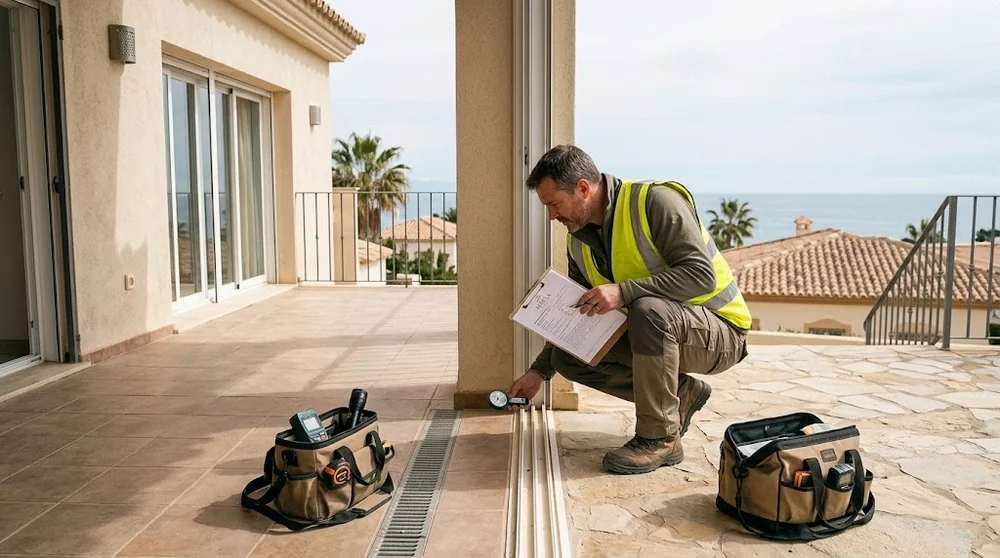
- Registry, Catastro and reality: compare the areas and description in the Land Registry, the Catastro and the physical property. Risk: extensions, enclosed terraces, basements or pools built without licences, some of which cannot be legalised. Budget consequence: legalisation costs, a price renegotiation or a decision to walk away.
- Licences and occupancy: ask for the licence history and the evidence of occupancy (in Andalucía, the documentation confirming the dwelling is fit for occupation). Risk: utility contracts, finance or resale can be harder without it. Budget consequence: regularisation work and professional fees, or a lender reducing the loan.
- Easements and urbanisation obligations: check rights of way, servitudes and any unpaid urbanisation charges. Risk: obligations that pass to the new owner. Budget consequence: one-off contributions or restrictions on future works.
- Ley de Costas exposure: Spain’s Coastal Law defines the public maritime-terrestrial domain, which cannot be privately owned. Under Article 23 of the Ley de Costas, as of October 2026, the ordinary protection easement extends 100 metres inland from the landward limit of the seashore, and it can be extended by up to a further 100 metres where the authorities agree it is needed. Transitional rules allow a narrower strip, generally 20 metres, for land that was already urban when the law came into force. Risk: limits on rebuilding, extending or replacing structures, and in some cases a concession rather than full ownership. Budget consequence: a lower realistic value, refused works or a renovation plan that cannot go ahead. Your lawyer should check the official boundary records and the property’s history.
- Salt, wind and storm exposure: ask the surveyor to assess railings, window frames, terraces and drainage. Risk: faster corrosion and water ingress. Budget consequence: a larger maintenance reserve and higher insurance.
A sea view is priced in — here’s how to judge if it’s worth it: confirm what you legally own, what you may build or replace, and whether exposure to wind and salt will raise maintenance. Not every sea-view home is affected by coastal law, and those that are can be affected very differently.
Rental and off-plan assumptions
If rental income influences affordability, verify each layer separately:
- Regional tourist-rental registration with the Junta de Andalucía and any municipal planning limits on holiday lets in the area.
- Community rules: from 3 April 2025, reforms to Spain’s Horizontal Property Law published in the BOE require express community approval for relevant new tourist-rental activity in apartment buildings; transitional situations need individual verification.
- National registration requirements for short-term rentals, which sit alongside regional rules. A registration number on its own does not prove every requirement has been met.
- Rental income is never assured, and seasonality on the coast affects occupancy considerably.
- For off-plan purchases, ask for the individual guarantee or insurance certificate issued in your name for each stage payment, not a general statement that the developer is insured.
- Check that the protected amount covers everything you advance, including the applicable VAT and legal interest, and that you pay only into the designated special account named in the guarantee.
- Confirm the building-licence status, the contractual completion date, the triggers for a refund if construction does not start or the home is not delivered on time, and the price of extras and contract exclusions.
If any of these points is unresolved before reservation, it is reasonable to make the contract conditional on it or to reflect it in the price.
Golden Mile, Benahavís or Estepona: Compare Like for Like
Buyers often shortlist across very different settings, and cost comparisons only work when the format is the same. Picture three hypothetical options: an apartment on the Marbella Golden Mile, a detached villa in Benahavís and a coastal apartment in Estepona. The ordinary regional purchase-tax framework is the same for all three; a more prestigious address does not change the ITP or VAT rate. What differs is what you are actually buying and who maintains it.
The Golden Mile apartment sits between Marbella town and Puerto Banús, with shops, restaurants and the beach within easy reach, and much of its upkeep is shared: the community budget covers gardens, pools, lifts, concierge or security and the building envelope. A detached Benahavís villa usually means more land and privacy in the hills behind the coast, but the owner carries the cost of the pool, garden, gates, retaining walls and systems directly, and daily life typically involves driving. An Estepona coastal apartment, further west along the coast, again shifts maintenance into a community structure; seasonality, access to the A-7 and AP-7 and the services within walking distance shape how it feels to live there through the winter months.
Municipalities set their own IBI rates and local charges, which affects annual costs. That is why we compare actual IBI receipts, community budgets and service quotes for shortlisted properties instead of quoting area averages. We also avoid predicting which location will resell better: that depends on the individual property and the market at the time.
If you are weighing two or three of these settings and want a quick sense of which format suits your budget and lifestyle, a short set of questions can narrow it down before you start requesting documents.
Not sure whether a resale villa or a first-delivery apartment fits your budget better? Take our short Costa del Sol buying-cost quiz to see which costs apply to your plans.
Whatever the result, treat it as a starting point for the documents below, not as a figure to commit to.
Before You Reserve: Request a Written Cost Review
A defensible budget is built from documents and stated assumptions. Before you pay a reservation, we suggest gathering the following:
- Transaction classification: resale or first delivery, with the seller’s supporting documents.
- Tax-base verification: the valor de referencia, if one exists, compared with the price.
- Written scope and quotation from an independent lawyer, plus a notary and registry estimate, and the expense allocation proposed in the contract.
- Technical survey scope and quotation suited to the property.
- Agency remuneration terms in writing, including any buyer-side agreement.
- An initial affordability assessment from a lender or broker: indicative loan amount, criteria for non-residents and a currency plan. The valuation, FEIN, the ten-day review period and the mortgage signing come later, so where funding is still uncertain, ask your lawyer to include a finance condition in the contract.
- A completion cash schedule showing deposits, balance, mortgage proceeds and expenses by date.
- Annual evidence: IBI and waste receipts, community budget, minutes and certificate of debts.
- Planning, coastal and rental checks relevant to your intended use.
- A tax adviser’s review of ownership structure and annual filings.
If you have a property or area in mind, our team can prepare a property-specific acquisition and annual-cost review. Tell us the target property or area, your budget, whether you will need finance and how you intend to use the home. We can organise the figures and documents; your independent lawyer and tax adviser must verify the legal and tax conclusions.
Have a specific villa or apartment on your shortlist? Send the Mirea team a message on WhatsApp and we will tell you which documents to request first for your cost review.
We reply with a document list and the questions your lawyer should answer, not with a sales pitch.
Costa del Sol Buying Costs: FAQ
How much extra should I budget for a luxury property on the Costa del Sol?
Start with the transaction’s taxes, then add written professional quotations. As of October 2026, ordinary Andalusian resales attract 7% ITP, while qualifying first-delivery homes generally attract 10% VAT plus 1.2% acquisition AJD. Legal work, registration, technical checks, financing and optional services increase the total. Furnishing and first-year ownership need separate allowances.
How do buying taxes differ between a resale and a new build?
As of October 2026, an ordinary residential resale in Andalucía generally attracts 7% ITP. A qualifying first delivery generally attracts 10% residential VAT plus 1.2% acquisition AJD. Classification depends on the transaction, not just the building’s appearance. An independent adviser should confirm the applicable tax bases, particularly where a cadastral reference value exists.
Do foreign or non-resident buyers pay higher purchase taxes?
Nationality or non-resident status alone does not increase the ordinary Andalusian resale ITP or residential VAT rate. However, eligibility for particular reliefs, financing terms and ongoing tax obligations can differ with personal circumstances. Non-residents should budget separately for applicable income-tax filings and obtain advice on wealth-related taxes before deciding how to hold the property.
Who pays the agent and mortgage costs?
The seller commonly pays the selling agency, but a separate buyer-representation agreement may create a buyer fee. Obtain written terms. For mortgages covered by Spain’s applicable consumer-credit rules, the lender generally bears mortgage-deed notary, registry, tax and administration expenses; the borrower pays the valuation. Separate purchase expenses and agreed loan charges still require budgeting.
How much does a luxury villa in Marbella cost to maintain each year?
There is no reliable annual figure without the property’s bills and service requirements. Request IBI and waste charges, community accounts where applicable, insurance and utilities, plus pool, garden, security and management quotations. Keep capital replacements and mortgage payments separate from routine running costs. Coastal exposure, building systems and occupancy patterns can materially change the budget.
No automatic exemption follows from buying in Andalucía. Regional wealth-tax rules interact with Spain’s solidarity tax, and liability depends on the applicable year, residence, taxable assets, debts, ownership shares and personal allowances. Filing obligations may also exist without a payment. Obtain an individual calculation under the rules applicable as of October 2026 before committing.
Conclusion
From our work along the Spanish coast, the buyers who complete calmly are the ones who settle three numbers early: the acquisition cost, the cash needed on completion day and the first-year running cost. They are different figures with different deadlines, and each one fails in its own way when it is guessed rather than documented.
The tax side becomes predictable once the transaction is classified and the tax base is checked against the reference value. Everything else, from the lawyer’s fee to the pool contract, should come from written quotes, official records and the property’s own bills, with coastal-law, planning and rental checks done before money changes hands, not after.
Get those documents on paper before the reservation, build the cash schedule by date, and have an independent lawyer and tax adviser confirm the conclusions. Then the sea view becomes a decision rather than a gamble.
Disclaimer: This article is general information prepared by the Mirea team and reflects rules as we understand them as of October 2026. It is not legal, tax or financial advice, and all monetary figures are illustrative. Tax rates, bases and deadlines can change; confirm every figure and conclusion with an independent Spanish lawyer, a qualified tax adviser and, where relevant, a technical specialist before committing to a purchase.
 Real estate in Georgia
 Real estate in Montenegro
 Real estate in Cyprus
 Real estate in the UAE
 Bali Real Estate
 Real estate in Thailand
 Real estate in Saudi Arabia
 Real estate in Turkey
 Real estate in Zanzibar
 +34 611 898 442
 hello@property-spain.es
 Spain



 Get catalogue of TOP-7 objects