
 +34 611 898 442


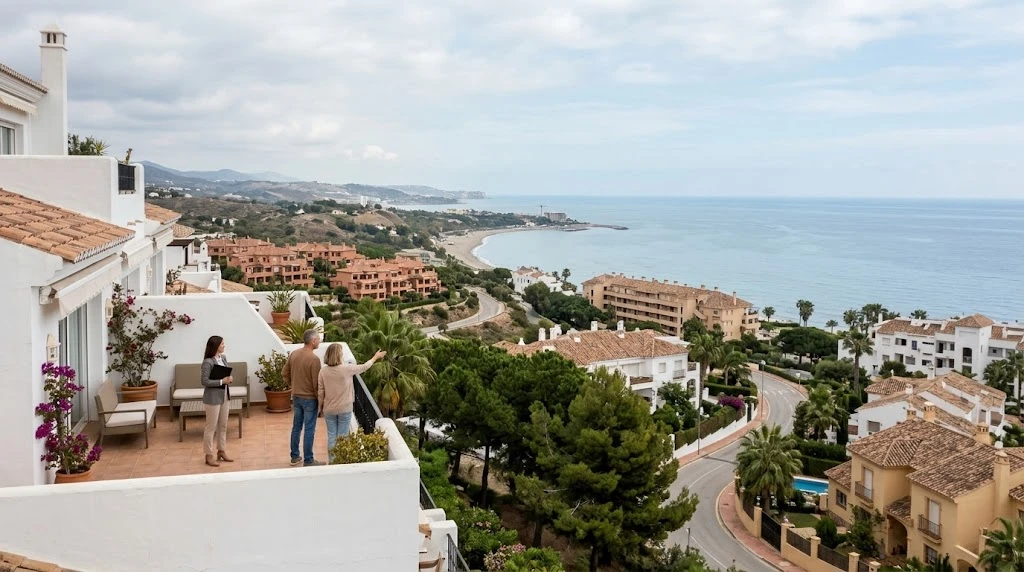
Buyers often assume that a shaky economy means cheaper homes by the sea. Spain’s official data from 2026 tells a more mixed story: prices were still rising at a double-digit annual pace while the European Central Bank was lifting its policy rate. The better question is whether a specific home, at a specific price, still works for you if conditions get worse. This article walks through the evidence, the financing mechanics and the coastal-specific risks that decide that.
Buying Spanish coastal property during economic uncertainty can make sense when the home suits your needs, the price is supported by local evidence and ownership remains affordable under adverse scenarios. Uncertainty does not automatically create bargains. Compare financing, currency exposure, total costs, legal restrictions and resale prospects before deciding whether to buy or wait.

Does uncertainty create a coastal buying opportunity?
Economic uncertainty reaches the property market through several channels at once. Employment worries make buyers cautious, inflation squeezes household budgets, tighter credit shrinks the amount lenders will offer, exchange rates change what foreign buyers actually pay, and low confidence slows decisions. All of these can reduce the number of people ready to buy. Weaker buyer sentiment does not, by itself, establish that a property is discounted, because sellers can simply wait, withdraw the listing or rent the home out instead of cutting the price.
From our work along the Spanish coast, we see two very different kinds of purchase hiding behind the same headline question. One is buying a home you will use: a place to live part of the year or retire to. The other is pursuing a short-term gain from a price move. Uncertainty affects these differently, and mixing them up is the source of much bad timing advice.
Here is how the three main buyer types differ in practice:
Lifestyle buyers who pay in cash mainly need the home to be right and the price to be defensible. Their main risk is overpaying for a location or view, and their timeline is flexible. Leveraged buyers depend on a lender, so their risk is a payment that rises or a mortgage offer that shrinks before completion. Income-dependent buyers who plan to cover costs with holiday rentals carry the most exposure, because both licensing rules and tourist demand can change. A purchase that only works if everything goes well is a bet, not a plan.
A sea view is priced in, and here is how to judge if it is worth it: ask what comparable homes with and without the view actually sold for in the same building or street, not what sellers are asking. In an uncertain market, that completed-sale evidence matters more than any headline about the economy.
What Spanish property data actually tells buyers
Property statistics are easy to misread because they measure different things. Asking prices record what sellers hope to receive and tend to move first. Valuations are appraisers’ estimates, often prepared for mortgage purposes. Transaction indices track prices of completed sales and usually arrive with a delay. Forecasts are opinions about the future and carry the widest error. Our evidence hierarchy puts official transaction statistics and central-bank documents first, valuation reports second, asking-price data third and forecasts last.
The table below summarises the main releases we relied on, as of October 2026. It also states what each one cannot tell you. The national index comes from the Instituto Nacional de Estadística (INE).
| Source | Reference period | Geography | Metric | Limitation |
|---|---|---|---|---|
| Instituto Nacional de Estadística (INE), Housing Price Index, published 7 September 2026 | Second quarter of 2026 | Spain, national | 12.2% annual and 3.4% quarterly growth; new homes up 7.4% and existing homes up 12.9% annually | National average; says little about a specific coastal town or building, and the figures are nominal |
| Tinsa Vivienda en Costa 2026, published 19 August 2026 | First quarter of 2026 | Spanish coastal areas, excluding coastal provincial capitals | 13.5% annual valuation growth (price level not shown) | Valuation-based rather than a transaction index, and excludes provincial capitals. Two publishers report different price levels per square metre, and we could not reconcile them against the underlying report, so we show the growth rate only and treat it as unverified |
| European Central Bank (ECB), decision of 10 September 2026 | Effective 16 September 2026 | Euro area | Deposit facility rate raised to 2.50% | A policy rate, not Euribor and not a retail mortgage rate |
Two distinctions matter most. First, nominal prices are not real prices: the INE index is not adjusted for inflation, so a 12.2% nominal rise represents a smaller gain in purchasing power. Second, slower growth is not falling prices. A market can cool from 14% to 8% annual growth and still be rising every quarter. The INE and Tinsa growth figures also come from different statistical products, so we never blend them into a single number.
Here is what that means in practice: the data supports the statement that national and coastal prices were rising strongly in the first half of 2026. It does not support a claim that prices are about to fall, nor that they will keep rising. The Banco de España publishes material on mortgage lending and household finances that is a useful companion when you want to see how credit conditions are developing.
Interest rates, Euribor and currency exposure
Three different rates get confused in conversation. The ECB policy rate is the central bank’s lever. Euribor is the market rate at which euro-area banks lend to each other, and it is the reference for many Spanish variable mortgages. A lender’s offer adds its own margin, fees and conditions on top. As of September 2026 the ECB deposit facility rate stood at 2.50%, but that figure tells you nothing precise about the mortgage you would be offered. Only a written quote does.
Cash buyers
Paying in cash removes repayment risk, yet it carries two costs that are easy to ignore. One is opportunity cost: the money could earn interest elsewhere, and the higher the deposit rate, the more that matters. The other is liquidity, because property cannot be sold quickly or in pieces. A cash buyer should confirm that, after paying the price and all purchase costs, enough accessible reserves remain for repairs, taxes and a long sale process.
A simple liquidity check we use with clients: add the purchase price and acquisition costs, subtract the total from your available capital, then compare what is left with twelve months of ownership costs plus a repair allowance. If the remainder would not cover that, the purchase is too large for your cash position, however attractive the price looks.
Mortgage buyers
For mortgage buyers, the affordability test is the payment under a higher rate, not today’s payment. With a variable rate, repayments follow Euribor and can rise at each review. A fixed rate gives certainty but is usually priced with that certainty built in, and early repayment can carry charges. We always tell clients to check the official standardised information sheet the lender must provide, and to ask for quotes from more than one lender. Please do not rely on a rule of thumb about non-resident loan sizes: lenders set their own limits case by case, and only a verified quote tells you yours.
In practice, ask each lender for the payment at the quoted rate and again at a rate two percentage points higher, on the same loan amount and term. Then check that your income, after your other commitments, still covers the higher payment together with the annual ownership costs. If the higher payment only works by cutting everyday spending to the bone, the loan is too large.
Buyers earning outside the euro area
If your income is in sterling, dollars or another currency, the euro price of a home is not the whole story. A weaker home currency raises the cost of the deposit, the purchase taxes, and every later bill. Two points apply: the price you agree is fixed in euros, but the amount you must convert is not, and a euro mortgage repaid from non-euro income carries ongoing exchange risk. Test the budget at a less favourable exchange rate than today’s, and consider whether to convert in stages or in advance with a regulated provider.
Why Spanish coastal markets respond differently
“The Spanish coast” is not one market. Demand type, year-round services and ease of access differ by region, and so does how quickly a property can be resold. The table below is our qualitative assessment, not a ranking of returns, and it uses selected towns only as examples.
| Area | Access | Year-round services | Seasonality | Typical buyer mix (assessment) | Supply and resale evidence |
|---|---|---|---|---|---|
| Costa del Sol (for example Marbella, Fuengirola) | Major international airport and motorway links | Broad services, healthcare and international schools in larger towns | Active across most of the year | International residents, second-home owners, some retirees | Large and varied stock; check recent completed sales in the specific urbanisation |
| Costa Blanca (for example Alicante, Dénia) | Airport at Alicante and good road links; Dénia is a ferry gateway to the islands | Strong in cities and bigger towns, thinner in some smaller resorts | Mixed; some resorts quieter in winter | Northern European buyers, retirees, domestic buyers | Wide price range; resale depends heavily on the specific urbanisation |
| Costa Brava (for example Begur) | Girona and Barcelona airports, longer drive from either | Good in larger towns, limited in small coves | Pronounced summer peak | Domestic and French buyers plus international second-home owners | Smaller stock in protected areas, so listings can be scarce and comparisons thin |
| Balearic Islands (for example Mallorca) | Air and ferry only, so access depends on seasonal schedules | Excellent around Palma, more limited inland and in small villages | Strong peak season, quieter winter in many areas | International buyers and wealthier second-home owners | Constrained supply in many areas; regulation of rentals and building is tighter in places |
| Canary Islands (for example Tenerife) | Air connections and mainland/inter-island ferries; compare journey times and service frequency for the specific island | Good in main resort areas and cities | Milder seasonality because of the climate | European winter-sun buyers, retirees, remote workers | Varied; resale depends on the specific resort and building |
Resale liquidity is where regions diverge most. In a large market with many buyers and many comparable sales, a fairly priced home can find a buyer without a deep discount. In a small, seasonal village the buyer pool is thinner, and the time to sell can lengthen sharply in a weak year. Neither is better in itself; the point is that the same national headline can mean very different things in Fuengirola, Begur and a quiet Tenerife village.

Buying now versus waiting: compare both outcomes
Waiting is not free, and buying is not irreversible in the way people fear. The table below sets out an explicitly hypothetical twelve-month comparison for a cash buyer using a €300,000 reference property. It is not a forecast.
Assumptions: acquisition costs of 10% of the price (an assumption, not a statement about any region’s actual taxes); rent of €1,200 per month while waiting (€14,400); net interest on retained cash of 2% after tax on €330,000 (€6,600); annual ownership costs of €4,500 (community charges, IBI, insurance and maintenance), which are avoided if you wait; no rental income either way, so nothing is counted twice.
| Price in 12 months | Cost of the same home including 10% acquisition costs | Change versus buying now | Carrying difference of waiting (rent minus interest minus ownership costs avoided) | Net economic result of waiting versus buying now |
|---|---|---|---|---|
| Minus 10% (€270,000) | €297,000 | €33,000 lower | €3,300 cost | About €29,700 better |
| Unchanged (€300,000) | €330,000 | No change | €3,300 cost | About €3,300 worse |
| Plus 5% (€315,000) | €346,500 | €16,500 higher | €3,300 cost | About €19,800 worse |
The carrying difference works as follows: €14,400 of rent, less €6,600 of interest earned and €4,500 of ownership costs avoided, leaves €3,300. This is an economic cost, not a cash-flow figure and not equity. If you buy now and prices fall 10%, the market value of your home and your equity fall immediately, even though the loss in sale proceeds stays unrealised until you sell. Lower equity is not just an accounting detail: it can limit your options when refinancing and make it harder to move or trade up. If you borrow, interest on the loan is a cost; the principal you repay is not, because it builds equity. A mortgage variant would need the loan rate, the amount and a smaller cash balance earning interest.
There are limits to this comparison. It ignores tax effects, the personal value of using the home sooner, and the chance that mortgage rates or your own income change over the year. It also compares a purchase you could make now with one you only hope to make later at a price you cannot know. Treat it as a way to see which variable matters most. In this example, the answer is the price move, not the carrying costs.
Stress-test the full cost of coastal ownership
A mistake we often see with beachfront buyers: budgeting for the price and the mortgage but not for the rest. Use the list below to build a no-surprises version of your budget. The amounts here are placeholders for you to replace with quotes.
- Acquisition costs (buyer’s purchase expenses): a resale home is generally subject to regional transfer tax, while a new-build is generally subject to value-added tax plus stamp duty, so the property type changes the bill. The Canary Islands have a separate indirect-tax regime, so do not apply mainland assumptions there. Add notary and registry fees, legal fees and any agency fee. Rates differ by region and change, so ask a Spanish property lawyer to confirm the current figures for your jurisdiction. The Agencia Tributaria publishes the national tax rules, including those for non-residents.
- Mortgage costs (kept separate from the purchase costs above): valuation, arrangement or opening fees, and the allocation of notary, registry and stamp-duty costs on the loan deed, which Spanish mortgage law distributes between lender and borrower. Ask the lender to show in writing which costs fall on you.
- Annual costs: IBI property tax, community charges, home insurance, utilities, and non-resident or other income-tax obligations where applicable. Ask the community for its budget and any approved special assessments for façade, lift or pool works.
- Maintenance: salt air, sun and humidity age balconies, windows and metalwork faster than inland. A recurring repair allowance is sensible, and management or cleaning costs apply if you are away.
- Exit costs: agency fees if you use an agent, taxes on any gain, local taxes tied to the transfer, and the time a sale may take.
Now combine them into one hypothetical downside test. These are stress-test assumptions, not forecasts and not a mandatory reserve rule. Suppose you hold a €200,000 variable-rate loan, with a starting rate of 3.5%, a remaining term of 25 years and a rate reset at the next annual review. The standard monthly repayment on those terms is about €1,001. If the rate resets two percentage points higher to 5.5%, the repayment on the same balance and term rises to about €1,228, an increase of roughly €227 a month, or about €2,700 over a year. As a deliberately simple cross-check, €200,000 × 2% gives roughly €4,000 of extra interest in the first year; we label that a simple-interest approximation, since the real amortising payment change is the smaller figure above. We use the more cautious €4,000 for the budget below.
Now separate two different problems. The first is annual liquidity need. You receive no holiday-rental receipts for 12 months, and you had budgeted €6,000 of net receipts (after platform fees, cleaning, tax and utilities), so you lose €6,000. An unexpected repair costs €8,000. Together with the €4,000 interest approximation, you need about €18,000 of extra cash in that year, on top of normal running costs. The second is an early-sale loss. Suppose you must sell earlier than planned at a price 5% below the €300,000 purchase price (€15,000 lower) with assumed selling costs of €12,000. That is a further loss of about €27,000, and it comes on top of the acquisition costs you already paid when you bought, which a sale does not give back. Keep the two figures apart: the €18,000 is cash you must find while you still own the home, and the €27,000 only arises if you sell.
Rent lost is not the same thing as gross yield. Gross receipts are a headline number; what you actually keep after costs and tax is the figure that pays your bills. Test whether you could carry the home through the first problem without being forced into the second. If you could not, the purchase relies on good luck, and a smaller budget may be the safer option.
If you would like to talk through the legal steps of a coastal purchase and how they apply to your own situation, a short one-to-one conversation can save time before you commit to a viewing trip.
Ask a question on WhatsApp for one-to-one advice on coastal property purchase and legal steps.
Once the numbers hold up under stress, the next question is whether the home itself is lawful and sound, because a good price on a problem property is not a bargain.
Check coastal legality before calling it a bargain
Economic conditions shape the market, but they do not change a property’s legal status. A low price can reflect a real defect that no amount of favourable timing will fix. We always tell clients to separate the macro question (is this a good moment?) from the property question (is this particular home legal, safe and insurable?). As of October 2026, our checklist covers the following, and each point should be confirmed by an independent Spanish property lawyer. The official gazette at boe.es publishes the Ley de Costas and regional legislation, and the Spanish notaries’ portal explains how the deed signing works.
- Title and charges: confirm the seller is the registered owner and that the property register shows no mortgages, seizures or other charges that would pass to you.
- Planning and permitted use: check that the building and any extensions, terraces or pools are legally licensed, and that the home’s registered use matches your intended use.
- Ley de Costas: the Coastal Law sets out the public maritime-terrestrial domain, a protection easement and rules about works and use near the shore. The general protection strip is 100 metres, measured inland from the inner limit of the seashore, and it can be extended in some cases. Transitional provisions can produce different widths for some areas and for older developments, so the general figure is not a universal parcel-level boundary. Ask to see the approved deslinde (the official survey of the boundary) and ask your lawyer which regime applies to the specific plot. Do not assume that a home near the beach is fully private freehold.
- Holiday-rental licences: these are regulated at regional and sometimes municipal level. A listing, existing rental activity or a registration number alone does not prove that you can lawfully rent out the home after you buy it. Existing licences or registrations should not be assumed to transfer or to permit your planned use.
- Community restrictions and approval: read the community statutes and minutes for rules on short-term lets, pets, works and pending charges. Checking whether a prohibition exists is only half the task. As of October 2026, under Articles 7.3 and 17.12 of the national Ley de Propiedad Horizontal as amended, tourist-use rental in a building under horizontal property can require the express prior approval of the owners’ community, and the community can also adopt restrictions. The exact position depends on transitional provisions and on the territorial legal framework that applies. Ask your lawyer to verify the rule for the specific building before you rely on any rental plan.
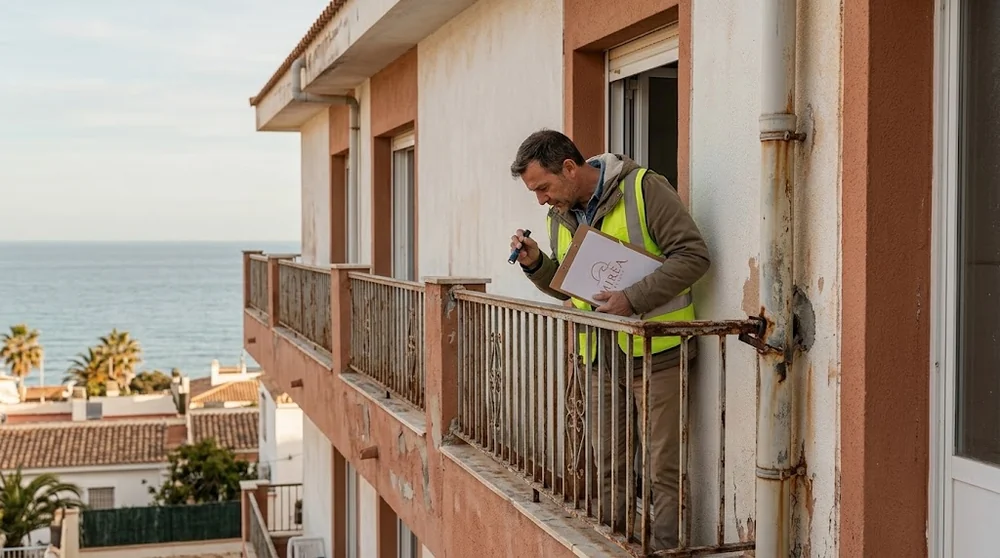
- Building condition: commission an independent survey, particularly for balconies, roofs, waterproofing and structural elements exposed to salt.
- Flood exposure and coastal erosion: ask about flood history and any official risk mapping for the location, and consider how beach retreat or storm damage could affect access and value.
- Insurance availability: get written quotes before signing, because cover or price can differ for flood-prone or exposed properties.
Buy, negotiate or wait: a practical decision
After the market data and the legal checks, the decision comes down to your own finances and the specific property. The criteria below are conditional, meaning each one depends on facts only you and your advisers can verify.
If you are still deciding which coast and budget fit your plans, a structured shortlist can narrow the search before you spend on flights and viewings.
Whichever route you take, treat the shortlist as a starting point and verify each property independently.
Reasons to buy can be reasonable when all of these hold:
- The home suits how you will actually use it, and you would still want it if prices stayed flat.
- Comparable completed sales, not just asking prices, support the price.
- The budget survives the stress test, including no rental income and a higher rate.
- The legal checks are complete and the surveyor found no unresolved problems.
Reasons to negotiate rest on evidence, not an assumed discount:
- Recent comparable sales are below the asking price.
- The survey identified repair costs you can document.
- The property has been listed for a long time, or the seller’s circumstances are verified and favour a quicker sale.
Reasons to wait are strongest when the foundations are not in place:
- Your finances, mortgage approval or currency position are unsettled.
- The legal status of the property or its rental use is unclear.
- You are unsure which coast and building type you want.
- The purchase only works if prices rise or the home earns holiday-rental income.
Indicators to monitor while you wait are lender quotes and Euribor, local listings compared with completed-sale evidence, the amount of supply in your chosen area, changes in regional rental regulation, and your own liquidity.
The short answer is that uncertainty is a reason for care, not a reason to rush or to delay. A purchase can be sound if the home fits, the price is evidence-based and the ownership costs remain manageable in a weaker year. Waiting has costs and benefits that depend on price changes, accommodation, cash returns and the ownership costs avoided.
Frequently asked questions
Is now a good time to buy property on the Spanish coast?
It can be, if the home fits your intended use, local comparable evidence supports the price and you can afford ownership through weaker conditions. Economic uncertainty alone does not establish value. Compare total costs, financing, currency exposure and legal restrictions, then test whether the purchase still works without capital growth or holiday-rental income.
Should I wait for Spanish property prices to fall?
Waiting can be sensible when your finances, location choice or property checks are incomplete. A nationwide fall is not a reliable planning assumption, and national growth does not rule out local reductions. Compare flat, rising and falling price scenarios, including accommodation costs, interest on retained cash and ownership expenses avoided while you wait.
How do interest rates affect buying a home in Spain?
Higher mortgage rates can increase monthly payments and reduce purchasing capacity, but the effect depends on the loan amount, term and rate structure. ECB rates, Euribor and a lender’s mortgage offer are different measures. Compare actual offers and test variable-rate exposure; buyers earning outside the euro area should also assess exchange-rate changes.
Is buying with cash better than taking a Spanish mortgage?
Cash removes mortgage repayment risk but ties up capital and reduces liquidity. Borrowing preserves some cash while introducing interest costs, lender conditions and potentially changing repayments. Compare the full financing cost with the value of retaining reserves and the return available on cash. Neither approach makes an overpriced or legally unsuitable property a sound purchase.
Can I afford a coastal home without holiday-rental income?
Test the budget with no holiday-rental receipts and include community charges, taxes, insurance, utilities, maintenance and any mortgage payments. This reveals how dependent the purchase is on a rental assumption. Before counting income, independently verify the intended rental use, applicable permissions, community restrictions and operating costs for the specific address.
Conclusion
Our view, offered as the team’s assessment and not as advice, is that the next decision is not “buy or wait” but “what do I need to verify first?” Start with the price: ask for completed-sale evidence for the same building or street before you accept any asking figure. The national data in 2026 showed strong price growth alongside rising policy rates, which is not a picture of a market handing out discounts.
Our assessment: a coastal home that still works with a higher rate, no rental receipts and an unexpected repair is a far safer purchase than one that depends on conditions staying kind.
Then establish the downside you can afford, using the stress test above, and resolve the property-specific risks that macroeconomics cannot price: Ley de Costas boundaries, rental permissions, building condition, flooding and insurance. Verify them before you fall for the view.
Disclaimer: This article is general information only and does not constitute financial, tax or legal advice. Statistics are cited for the periods shown and legal points are stated as of October 2026; both can change. Property is illiquid and purchase costs are significant. Consult an independent Spanish property lawyer, a tax adviser and a suitable mortgage or financial specialist before making a decision.
 Real estate in Georgia
 Real estate in Montenegro
 Real estate in Cyprus
 Real estate in the UAE
 Bali Real Estate
 Real estate in Thailand
 Real estate in Saudi Arabia
 Real estate in Turkey
 Real estate in Zanzibar
 +34 611 898 442
 hello@property-spain.es
 Spain



 Get catalogue of TOP-7 objects